
Godgifu, Malet, and the Dragon of Lincolnshire

Updated: Aug 20

This scroll moves from symbolic architecture into land.
Its people and places do not all belong to the same evidential register. Godgifu gives an older Mercian memory. William Malet, Thorold/Turold, and Countess Lucy form a debated genealogical reconstruction. Ranulf of Chester, Hugh Bardulf, and Ralph de la Haye then enter a much firmer charter-and-land field. Castle Carlton's dragon belongs to folklore. Nicholaa de la Haye returns us to secure medieval custody at Lincoln Castle.
Held in that order, the route becomes stronger:
Mercian memory → Norman gate → Lincolnshire inheritance → Chester service → Bardulf land → de la Haye transfer → dragon folklore → castle custody.
Godgifu: The Gift Before the Gate
Godgifu, later Lady Godiva, was a real eleventh-century Mercian noblewoman: wife of Leofric, mother of Ælfgar, landholder and religious patron. An authentic charter of 1053–55 places Leofric and Godgifu in the endowment and ordering of Stow, while a separate Worcester gift preserves them as protectors or guardians — hald and mund — for life.
Her Old English name carries the sense “Gift of God.”
The famous ride belongs to later legend rather than contemporary biography, and the Peeping Tom episode is later still. Yet those traditions gave Godgifu a durable symbolic field around mercy, taxation, exposure, sacrifice, and the ethics of looking.
That is why she remains important here.
The historical woman belongs to pre-Conquest Mercia.
The later legend asks whether power can be softened by mercy and whether the sacred can be witnessed without violation.
Godgifu therefore enters the scroll as older Mercian memory, not as a genealogical shortcut into every later Lincolnshire family.
William Malet: The Conquest Gate
William Malet stands close to the rupture of 1066.
William Malet stands in a firmer position at the Conquest gate than this scroll once allowed. William of Poitiers explicitly entrusts Harold’s burial after Hastings to Malet and records him refusing Gytha’s offer of gold for the body; the same writer later places Harold in a seashore tumulus. The body’s later history remains disputed, but Malet’s first-stage custody is a hard documentary role.
That role makes Malet a genuine hinge between fallen English kingship and the new Norman settlement without requiring a blood connection to Godgifu.
That route remains open and uncarried by decisive contemporary evidence.
Its proper use is as a research question:
Could Malet’s English connections and his custody role help explain why later reconstructions around Turold, Lucy, Malet and Godgifu repeatedly became entangled?
For now, Malet is secure as the Norman gate and as a custodian in Harold’s burial narrative. Any maternal route back toward Godgifu’s family-world remains a working hypothesis.
Eye: The Symbolic Afterimage
The Malet family became strongly associated with Eye in Suffolk.
That place-name acquires symbolic force inside a project already concerned with Godiva and Peeping Tom, right and wrong seeing, woodland eye-forms, and later dragon traditions.
The historical claim is simply place and lordship.
The symbolic recurrence comes afterward:
old kingship falls;
Malet enters the Conquest settlement;
his family-world holds Eye.
No hidden design is required for the image to remain useful.
Thorold: The Lincoln Door
Between Malet and Lucy stands the difficult figure of Thorold / Turold, associated with Lincolnshire, Bucknall, Spalding, and later genealogical debate.
Later Crowland and Spalding traditions sometimes make Thorold a brother or close kinsman of Godgifu. That language belongs to a later and less secure clock and cannot carry the bridge by itself.
The harder evidence lies around Turold. A c.1070 Stow confirmation addresses a sheriff Turold in the post-Conquest handoff of the church’s lands; Spalding tradition later remembers Lucy as Turold’s heir; and an Ivo-and-Lucy benefaction calls Turold and his wife their antecessores. Modern prosopographical reconstruction therefore places Lucy as daughter or heir of Turold with Malet ancestry behind her.
Some later pedigrees supply the Malet daughter with the name Alvarissa. That name should be treated cautiously unless an earlier carrier is found.
So the working route is best stated without pretending every element is equal:
William Malet
→ an unnamed Malet daughter in the reconstruction
→ Thorold/Turold
→ Countess Lucy.
This is a serious historical hypothesis, not an uncontested pedigree.
Turold/Thorold is therefore the Lincoln door rather than a solved identity. The office, church-land and inheritance language are real; the exact concordance between every Turold/Thorold reference and the proposed family structure remains open.
Countess Lucy: The Land-Carrier
Countess Lucy is the major historical hinge.
Whatever the final verdict on her parentage, her own Lincolnshire power is substantial. She held extensive lands, married into major Anglo-Norman houses, became Countess of Chester, and was a significant religious patron in the Spalding world.
The Malet–Turold reconstruction matters because it offers one possible explanation for how an earlier Conquest-era inheritance entered her Lincolnshire field.
Her marriages then carried her land and status into wider political networks, most importantly the Chester earldom.
Through Lucy and Ranulf le Meschin came Ranulf de Gernon, Earl of Chester.
At this point the route begins to harden, because Chester later supplies a documentary carrier to Hugh Bardulf.
Lucy is therefore best understood as the land-carrier.
The genealogy behind her remains graded; the inheritance and political field around her are real.
Chester Gives Bardulf the Ground
A charter of Ranulf II de Gernon, Earl of Chester, grants Hugh Bardulf the demesne of Waddington in Lincolnshire, probably c.1142–46, for the service of three knights.
That is one of the strongest links in the entire sequence.
It places Bardulf inside a documented Chester service-field rooted in Lincolnshire. Ralph de la Haye, William Bardulf and Hamelin Bardulf appear among the witnesses, and the same charter explicitly reserves terra militum sancti Templi Ierussalem — land of the Knights of the Temple of Jerusalem.
Nothing symbolic is needed to join these names here.
The record does it.
So the line can now be stated firmly:
Lucy carries the Chester inheritance-field; Chester gives Bardulf Waddington for service.
That is land and charter, not bloodline speculation.
Ralph de la Haye and Castle Carlton
The Bardulf and de la Haye worlds meet again through Castle Carlton.
Manorial history places the site after the Conquest with Ansgot of Burwell and then Ralph de la Haye; by the mid-twelfth century, Hugh Bardulf had acquired Carlton from Ralph.
That transfer gives the project a second strong physical carrier after Waddington.
Waddington places Bardulf in Chester service.
Castle Carlton places Bardulf in a de la Haye land-transfer.
Then folklore gives the place its dragon.
Hugh Bardulf and the Dragon
The story of Hugh Bardulf and the Castle Carlton dragon belongs to folklore and local memory.
It should not be used as biography for the historical royal administrator Hugh Bardulf. Its value lies in reception: a documented medieval landholder and royal servant became attached in later memory to a monster-slaying story at one of the sites he actually held.
Some versions emphasise the dragon's eye, giving the legend an especially strong recurrence beside the project's wider concern with sight and witness.
Historically, Bardulf was a royal administrator, justice, sheriff, and servant across the reigns of Henry II, Richard I, and John.
Folklore turns that administrative figure into a dragon-slayer.
That transformation is the interesting thing.
The legal land-field supplies the man and place.
Later memory supplies the beast.
Dragonby: The Dragon Becomes Landscape
Lincolnshire contains another dragon-memory at Dragonby, where local tradition attaches a dragon turned to stone to the landscape.
The legend belongs to a different place and story from Castle Carlton and should remain separate.
Symbolically, however, the two create a useful pair:
at Castle Carlton, the dragon becomes a test attached to lordship;
at Dragonby, the dragon becomes stone and place-memory.
That recurrence sits naturally beside older British and Arthurian traditions in which dragons, stone, land, and sovereignty are repeatedly brought into relation.
It is symbolic architecture, not historical derivation.
Nicholaa de la Haye: The Castle Held
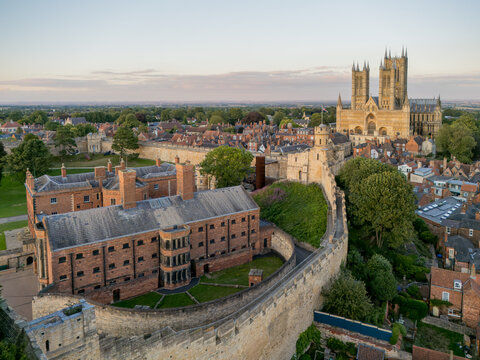
The de la Haye name reaches its strongest Lincoln chamber in Nicholaa de la Haye.
Nicholaa was hereditary constable of Lincoln Castle and one of the most remarkable female castle-holders of medieval England. She had already defended the fortress in an earlier crisis and, in 1217, held it for the young Henry III while royalist forces under William Marshal moved to relieve Lincoln.
Her role is secure and practical.
She held the castle.
This gives the scroll a clean contrast with its earlier female figures:
Godgifu gives an older Mercian memory of mercy and patronage.
Lucy carries land and inheritance through the Chester field.
Nicholaa exercises hereditary custody in stone.
They are not one archetype disguised as three women. Their real histories are what make the recurrence meaningful.
Lucy and Norman at Lincoln Castle
In the modern visitor landscape, Lincoln Castle has also displayed dragon sculptures named Lucy and Norman.
That is a present-day naming coincidence, not medieval evidence.
Yet within the symbolic register it is almost impossibly neat:
Lucy — the great Lincolnshire heiress in the working Malet/Turold route.
Norman — the Conquest world that transformed the land.
Dragons — inside the castle later defended by Nicholaa de la Haye.
The correct category is symbolic recurrence / modern reception.
It can be enjoyed without being asked to prove anything ancient.
The Bridge Held Carefully
The old version of this scroll repeated one formula as though every step had equal strength. The evidence now gives a better structure.
Secure / strong:
Godgifu as Mercian noblewoman and patron.
William Malet as Conquest-era lord with major English holdings and Eye connection.
Lucy as powerful Lincolnshire heiress and Countess of Chester.
Ranulf of Chester's grant of Waddington to Hugh Bardulf.
Ralph de la Haye's presence in the same service-world and the Carlton transfer.
Nicholaa de la Haye's hereditary custody and defence of Lincoln Castle.
Working reconstruction:
Lucy as daughter of Turold and an unnamed daughter of William Malet.
any maternal Malet link back toward Godgifu's family-world.
the later name “Alvarissa” for the proposed Malet daughter.
Folklore / recurrence:
Bardulf and the Castle Carlton dragon.
Dragonby's petrified dragon tradition.
Eye as symbolic sight-language.
the modern Lucy and Norman dragons at Lincoln Castle.
That grading makes the bridge more compelling because it shows exactly where the ground is firm and where the older stories begin.
Keeper Lines
Godgifu gives the older Mercian memory.
Malet gives the Conquest gate.
Thorold opens the disputed Lincoln genealogy.
Lucy carries the Lincolnshire inheritance into Chester.
Chester gives Bardulf Waddington for service.
Ralph de la Haye meets Bardulf in charter and land.
Castle Carlton gives the later dragon tradition.
Dragonby gives another Lincolnshire dragon-memory in stone.
Nicholaa de la Haye holds Lincoln Castle.
The route no longer needs a single hidden bloodline to work.
It is a sequence of memory, reconstruction, inheritance, service, land-transfer, folklore, and custody—each allowed to speak in its own register.


Comments