
Alkborough Before the Orders

Updated: Aug 20

Before the Templars, before de la Haye, before Slaney, before the living carvings, and before the later mystery begins to speak through the wood, there is a place.
Alkborough.
In the older record it appears as Alchebarge. But the deeper we look, the less it behaves like ordinary background. Alkborough becomes a meeting-point: ancient ground, Christian custody, Domesday transfer, Mercian memory, Norman settlement, female inheritance, castle power, and later sacred orders.
The evidence resolves into two interacting lines of land, custody and inheritance rather than a single demonstrable bloodline from Godiva to Malet to Lucy to de la Haye. Its complexity is the point: the record behaves as a braid.
What appears is a braid rather than a straight line.
One stream runs through Godiva, Thorold, Malet, Ivo, Lucy, Roumare and Chester; another through Colswain, Picot, Muriel, Robert de la Haye, Richard de la Haye and Nicholaa.
The first gathers around Alkborough, the second around Lincoln Castle, and together they meet in the same Lincolnshire corridor just before the Templars and Premonstratensians enter the landscape.
1. Alkborough is not ordinary ground
Alkborough must come first because it is the fixed point.
The modern landscape already gives clues before the medieval record is even opened: Kell Well, Julian’s Bower, Countess Close, St John the Baptist Church, Roman and Romano-British traces, the water, the maze, the church, and the later woodland signs that first pulled this investigation into a living field rather than a dead archive.
The carvings, marks, initials, hearts, names and figures belong to the Field Witness layer. The medieval record independently shows Alkborough as church-ground, priory-ground, manor-ground, abbey-ground and later countess-ground: the place where the pattern becomes land.
2. Thorold before Malet: the sacred custody layer
Before Malet is named at Alchebarge, Thorold has already touched the place through the church.
The Thorold material is not simple, and we should not pretend it is. There may be one Thorold remembered in two directions, or two related Thorold traditions that became braided together. But either way, the name appears exactly where the bridge needs it.
The Thorold memory presents two faces. One looks backward toward Godiva, Bucknall, Crowland, Spalding, Alkborough and pre-Conquest Christian custody; another looks forward toward the Lincoln sheriffdom, a Malet daughter, Lucy of Bolingbroke, Ivo, Roumare and Chester.
Another Thorold looks forward:
The first face of Thorold is the older sacred-land figure.
He is remembered as Thorold of Bucknall or Buckenhale, a sheriff of Lincoln and a founder/donor figure connected with Spalding Priory around 1051–1052. Alkborough itself appears in that sacred orbit through the church and Benedictine cell connected to Spalding.
This places Alkborough in Christian custody before Norman lordship: church, cell and priory connection before Domesday.
Thorold gives the church before Malet holds the manor.
3. Godiva and the old Mercian chamber
To understand why Thorold matters, we need to look back into the world of Godgifu, remembered as Lady Godiva.
Godiva was married to Leofric, Earl of Mercia. Their world was the old Mercian ruling world before the Norman Conquest: Christian, aristocratic, landed, and powerful.
Godiva is not just a romantic legend. In this Scroll, she is the image of an older female land-memory before the fall.
Mercia had once been a kingdom. By Godiva’s day, it was an earldom inside a larger English realm, but it still carried old weight.
Leofric and Godiva belonged to that world of earls, abbeys, estates, churches, and regional authority.
The documentary core is stronger than the later riding legend. An authentic charter of 1053–55 places Leofric and Godgifu in the endowment and ordering of Stow, giving the Mercian chamber a direct institutional carrier.
A separate Worcester gift preserves Godgifu and Leofric as protectors or guardians — “hald and mund” — for life. Sacred custody here is therefore an action recorded in land and church instruments, not merely a later image of generosity.
Godgifu gives us the old chamber of Mercia through landholding, female patronage and guardianship before the Conquest. That is the ground into which the Thorold/Turold question enters.
Then the line moves closer to the crown.
Godiva and Leofric’s son was Ælfgar, Earl of Mercia. Ælfgar’s daughter Ealdgyth married Harold Godwinson in early 1066.
That means the last Anglo-Saxon king was married into Godiva’s descendant line just before the kingdom fell.
When Harold dies at Hastings, the old Mercian female memory is close to the fallen body of the king.
4. Thorold and Godiva: the name beside the old memory
Later Crowland and Spalding traditions place Thorold close to Godgifu, sometimes even calling him her brother. That kinship language belongs to a later and less secure clock.
The harder documentary point lies nearby rather than inside that claimed brotherhood.
The important point is this:
Around 1070, a Stow confirmation addresses a sheriff Turold in the post-Conquest handoff of the church’s lands. Spalding tradition later remembers Lucy as Turold’s heir, while an Ivo-and-Lucy benefaction calls Turold and his wife their antecessores.
That combination is the reason he matters.
He is not simply a loose name.
He stands at the doorway between old Mercia and Lincolnshire’s sacred custody.
So the Scroll should hold him carefully:
The secure and strong carrier is therefore a sequence of office, church land and inheritance language around Turold/Thorold. Whether the Turold of the post-Conquest Stow instrument is identical with every Thorold of the older tradition, and whether Godgifu was genuinely his sister, remain separate questions.
And soon, through Lucy, he becomes the Malet-side bridge.
5. Hastings: Harold falls, Malet receives the body
Then comes the Conquest hinge.
On 14 October 1066, Harold Godwinson falls at Hastings.
Harold is not just any king. He is the last crowned Anglo-Saxon king of England. Through Ealdgyth, he is also married into Godiva’s descendant line.
William of Poitiers explicitly places William Malet in the custody of Harold’s burial after Hastings and records Malet refusing Gytha’s offer of gold for the body. The same writer later places Harold in a seashore tumulus, while the Carmen independently gives a coastal or cliff-side burial setting. The body’s later history remains disputed; Malet’s role in the first burial stage is much firmer than a later antiquarian memory.
A king’s body carried legitimacy, memory and danger — the old kingdom made flesh.
If Harold’s body became a shrine, the old order could gather around it. If it was dishonoured, the new order risked appearing cursed. The body had to be handled by someone trusted.
Malet becomes the hinge-man.
He stands between the old crown and the new regime.
And then the record places him at Alkborough / Alchebarge.
That is why this moment matters.
The man associated with Harold’s body is also the man attached to the Lincolnshire ground that had already been touched by Thorold’s sacred custody.
The old king falls; Malet receives the body; Alkborough enters the Conquest record.
6. Malet at Alchebarge: the Conquest manor
Domesday gives the hard land anchor.
For the main Alkborough holding, William Malet is named as lord in 1066, while Ivo Taillebois holds it by 1086.
That means Malet is not only symbolically connected to the old kingdom through Harold’s body. He is physically attached to the same ground we are tracing.
The land sequence is layered rather than flat: Thorold touches Alkborough through church and priory, Malet holds the main manor at the Conquest, Ivo holds it by 1086, and Peterborough Abbey appears in the smaller Domesday holding.
7. Ivo Taillebois: Peterborough, Domesday, and the door to Lucy
Ivo Taillebois must not be treated as a passing name.
He is one of the essential hinges.
By 1086, Ivo holds Alkborough in the Domesday frame. But he also sits inside the monastic land-world. One Alkborough layer is connected with Peterborough Abbey, and Ivo appears as lord in that frame.
This matters because Alkborough is not simply moving from Malet to Ivo as secular land. It is also moving through an abbey field: Spalding on one side, Peterborough on the other.
Thorold gives the church into Spalding custody.
Peterborough appears in the Domesday frame.
Ivo stands in the middle.
Then Ivo marries Lucy of Bolingbroke.
That marriage makes Ivo a doorway between Malet’s 1066 manor, Peterborough’s abbey interest, Spalding’s sacred custody and Lucy’s inheritance field.
Ivo is the hinge-door rather than the final answer: the land moves through him toward Lucy, where the pattern becomes familial.
And Lucy is where the pattern becomes family.
8. Lucy: where Thorold and Malet meet
Lucy of Bolingbroke is the central carrier of this Scroll.
A strong genealogical reconstruction identifies Lucy as the daughter of Turold or Thorold, sheriff of Lincoln, by a daughter of William Malet.
Through Thorold, she receives the Lincolnshire sacred/office world.
Through Malet’s daughter, she receives the Conquest/Alkborough/Harold-body field.
Through Ivo, she is drawn into the Domesday/Peterborough/Alkborough handover.
Lucy is where the story becomes visible.
This is also where the female-thread pattern becomes impossible to ignore.
The line does not pass forward loudly through a famous son.
It passes through a woman whose own mother is only half-seen in the record:
a daughter of William Malet.
That is exactly the kind of hidden female bridge the Scrolls keep finding.
9. Lucy’s marriages: Ivo, Roumare, Chester
Lucy then becomes the chamber through which the Lincolnshire field expands.
Her marriages matter because each one opens a different door.
First comes Ivo Taillebois.
Ivo holds Alkborough by Domesday and brings Lucy into the immediate post-Conquest land frame.
Then comes Roger fitz Gerold / de Roumare.
From this marriage comes William de Roumare, who carries the Lincolnshire and Bolingbroke estate-current.
Then comes Ranulf le Meschin, Earl of Chester.
From this marriage comes Ranulf de Gernon, Earl of Chester, bringing the military weight of one of the great regional powers.
So Lucy produces two streams that later act together:
William de Roumare — estate, Bolingbroke, Lincolnshire body.
Ranulf de Gernon — Chester power, military force.
Roumare and Chester are not random allies.
They are Lucy’s sons from different marriages.
Lucy’s inheritance splits into two powers.
Then those powers reunite at Lincoln.
10. William de Roumare: Lucy’s land becomes political force
William de Roumare is the man who brings Lucy’s inheritance to the castle.
He is not just Lucy’s son. He is the political body of her Lincolnshire estate-current.
His importance lies in where he stands:
behind him: Lucy, Thorold, Malet, Ivo, Bolingbroke
beside him: Ranulf de Gernon, his half-brother
before him: Lincoln Castle and the Anarchy
In 1141, William de Roumare and Ranulf de Gernon become central to the crisis at Lincoln Castle. They seize the castle, Stephen comes against them, and the struggle pulls Lincoln into the heart of the civil war between Stephen and Matilda.
This is where Lucy’s inheritance becomes national.
Before this, Alkborough is the anchor.
Now Lincoln Castle becomes the test.
Roumare brings the land-current.
Chester brings the army.
Together, they force the question of England into Lincoln.
11. The Anarchy: Lucy’s streams reach Lincoln Castle
The Anarchy begins after Henry I dies in 1135.
Stephen seizes the throne, though Henry’s daughter Matilda had been named heir. The kingdom breaks into civil war.
Lincoln Castle becomes one of the pressure points.
The chronology is clear: Henry I dies in 1135; in 1141 William de Roumare and Ranulf of Chester seize Lincoln Castle from Stephen’s forces; Stephen is defeated and captured; and the Roumare/de la Haye network becomes a major pro-Matilda power bloc in the north.
This is the moment the first stream reaches the fortress:
Alkborough → Thorold → Malet → Ivo → Lucy → Roumare / Chester → Lincoln Castle.
That is one side of the braid.
But it is not the whole braid.
Because de la Haye has its own older Lincolnshire stream.
12. Colswain / Kolsveinn: the hidden Lincoln root
This is the part that makes de la Haye land properly.
For a while, it looked as if de la Haye appeared too late, simply as the castle family after the Anarchy. But the trail runs deeper.
It runs through Colswain / Kolsveinn of Lincoln.
Kolsveinn appears as a significant Lincolnshire landholder in the Domesday world. His name carries a Danish/Norse flavour, fitting the Danelaw world of Lincolnshire. He represents a local landholding current that survives into the Domesday order.
The trail then runs:
Colswain / Kolsveinn of Lincoln
↓
Picot of Lincoln
↓
Muriel of Lincoln
↓
Robert de la Haye
↓
Richard de la Haye
↓
Nicholaa de la Haye
This is the missing de la Haye mechanism.
The de la Haye family does not simply appear.
It marries into, or succeeds into, an older Lincolnshire land stream.
That means de la Haye is not outside the pattern.
It is the parallel stream.
13. Muriel of Lincoln: the second female bridge
Just as Lucy carries Thorold and Malet into Roumare and Chester, Muriel of Lincoln carries Colswain and Picot into de la Haye.
This is the second female bridge.
Malet daughter → Lucy
Muriel of Lincoln → de la Haye
Nicholaa de la Haye → castle key
Muriel is the doorway by which the Colswain/Picot inheritance reaches Robert de la Haye.
14. Robert and Richard de la Haye: the castle office
Through Robert de la Haye and then Richard de la Haye, the second stream becomes attached to Lincoln Castle.
Robert de la Haye is connected with the hereditary constableship of Lincoln Castle and the sheriffdom of Lincolnshire. His son Richard continues the line. Henry II later confirms Richard in his father’s Lincolnshire lands and castle office after the Anarchy.
This is the exact point where the second stream meets the first.
The first stream — Lucy, Roumare, Chester — makes Lincoln Castle decisive in the Anarchy.
The second stream — Colswain, Picot, Muriel, de la Haye — becomes the hereditary castle-office line.
Then Henry II locks the key into place.
So the connection is not:
Lucy directly becomes de la Haye.
The connection is:
Lucy’s stream brings the crisis to Lincoln Castle.
Muriel’s stream brings de la Haye into the old Lincoln land.
Henry II confirms de la Haye in the castle office after the crisis.
The river is braided, not straight.
15. Nicholaa de la Haye: the woman holds the key
The pattern reaches one of its clearest forms in Nicholaa de la Haye.
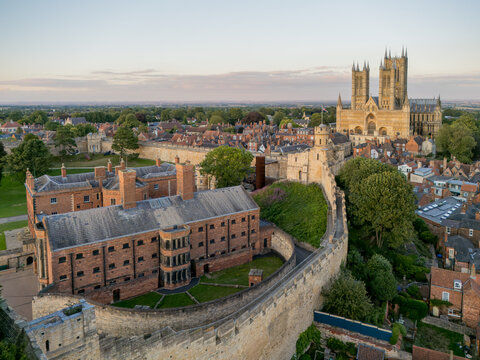
Nicholaa inherits the role of constable of Lincoln Castle. She later defends the castle during the First Barons’ War in 1217, holding the fortress until William Marshal arrives and the royalist forces win the Second Battle of Lincoln.
She is best read as the visible summit of the second stream, not as an isolated heroic figure appearing from nowhere.
She is the visible summit of the second stream:
Colswain → Picot → Muriel → Robert de la Haye → Richard de la Haye → Nicholaa
And she mirrors Lucy: Lucy carries the hidden inheritance; Nicholaa holds the visible key.
16. Barlings: de la Haye opens the Order-door
The de la Haye stream also opens the door to the new Orders.
This is where Barlings Abbey matters.
Barlings Abbey was founded in 1154 by Ralph de Haye, son of the constable of Lincoln Castle, as a Premonstratensian house. That detail matters because it ties the de la Haye castle stream directly into the arrival of the White Canons.
This is a major crossing: de la Haye is both castle custody and sacred-order patronage.
So the second stream moves like this:
The second stream therefore moves from older Lincolnshire land through Muriel into de la Haye, through the castle office, and then through Ralph de Haye’s foundation of Barlings into Premonstratensian custody.
That makes the bridge much stronger.
17. The Orders arrive into prepared ground
Only now should the Templars and Premonstratensians fully enter the Scroll.
The Orders arrive into ground whose charge has already been formed by older custody, inheritance, war, office and religious patronage.
The 1066–1180 builder document places Hugh de Payens in England in 1128–1129, Newhouse Abbey around 1143, Barlings Abbey in 1154, and Temple Bruer / Aslackby around 1150–1160, all in the same wider Lincolnshire corridor.
By then the corridor has already passed through Godiva’s Mercian memory, Thorold’s sacred custody, Alkborough’s Benedictine cell, Malet’s Conquest manor, Harold’s burial hinge, Ivo and Peterborough, Lucy, Roumare and Chester, Colswain and Muriel, de la Haye’s castle office, and Ralph de Haye’s Barlings foundation.
The Orders arrive late in the Scroll.
The land was already speaking.
19. Why the findings matter
The modern field observations belong beside, but not inside, the documentary genealogy: Kell Well, Julian’s Bower, Countess Close, St John the Baptist Church, the woodland, the carvings, the heart and the names all remain part of the witness layer.
Their value is cumulative and topographic: the same landscape repeatedly concentrates sacred custody, female inheritance, land transfer, buried kingship, monastic return, castle office, order foundation and later witness.
Closing reflection: the ground was already sacred
Alkborough was never just background.
Before Malet, Thorold had marked the church.
Before Ivo, Malet had held the manor.
Before Lucy’s sons fought at Lincoln, Lucy had carried the Thorold and Malet field.
Before de la Haye held the castle, Muriel had carried Colswain’s old Lincolnshire stream into that family.
Before the Orders arrived, the ground had already passed through church, manor, abbey, marriage, inheritance, war, office, and female custody.
So the final map is not a straight line.
It is a living braid:
Thorold gives the church.
Malet receives the king and holds the manor.
Ivo receives the land and opens the door to Lucy.
Lucy carries Thorold and Malet into Roumare and Chester.
Roumare and Chester bring the crisis to Lincoln Castle.
Muriel carries Colswain into de la Haye.
Henry II gives de la Haye the key.
Nicholaa holds the castle.
Ralph de Haye opens Barlings to the White Canons.
The Orders arrive into prepared ground.
And this is where history begins to sound like story.
For in the next Scroll, we will turn toward Geoffrey of Monmouth, King Lear, Shakespeare, and the daughters who carry the broken realm. The pattern is already here in the records: kings fall, male lines fracture, women carry the land, and the castle waits for the one who can truly hold it.
Godiva.
Malet’s daughter.
Lucy.
Muriel.
Nicholaa.
They are not Lear’s daughters.
But they stand in the same symbolic chamber.
The later symbolic bridge rests on earlier documented patterns of gift, body, church, manor, inheritance and castle custody.
The ground was already sacred.
The Orders only arrived later.

Comments