
Lady Nicholaa de la Haye: The Castle Guardian and the Female Thread in the Bridge

Updated: Aug 20

There are moments when a single historical person seems to embody an entire function.
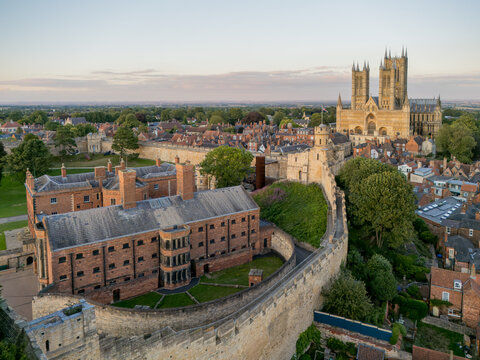
In 1217, during the civil war that followed Magna Carta, Lincoln became one of the decisive theatres in the struggle over the young Henry III’s realm. Lincoln Castle remained in royalist hands under Nicholaa de la Haye, a hereditary castle custodian whose legal and administrative activity was already established long before the battle.
She refused to surrender.
William Marshal led the royalist relief coalition that culminated in the Battle of Lincoln on 20 May 1217. Roger of Wendover later gives the plundered city the bitter “Fair” framing; that moral aftermath belongs particularly to his chronicle rather than to every surviving battle witness.
A Woman Who Held the Castle
Nicholaa, whose name also appears as Nicola or Nichola de la Haie, inherited the castle custody through her family. She had already defended Lincoln Castle in the crisis of 1191 and was again at the centre of its defence in 1216–17. Her charters, letters, seal and offices establish independent legal agency before the battle story turns her into a famous defender.
Her authority was practical and documentary. The History of William Marshal calls the defending woman castellan; an independent Anglo-Norman chronicle, the Histoire des ducs, remembers “Madame Nichole” as holding the castle by inheritance and keeping it loyally. Royal records place her inside castle custody and local government on their own administrative clock.
The battle narratives themselves disagree over parts of the choreography — approach route, entry mechanics, force numbers and even who struck the Count of Perche. That disagreement strengthens the method rather than weakening Nicholaa: the battle is secure, her custody is multi-source, and the colourful tactical details remain source-specific.
For this project, Nicholaa is therefore a secure historical guardian before she is any kind of symbol.
The Female Guardian
Within the Greater Bridge, Nicholaa occupies the castle chamber:
castle → temple → sanctuary → law → cathedral → craft.
Thomas Becket's murder represents royal violence spilling into sacred space. Nicholaa represents another use of force and office: disciplined guardianship at a moment when the realm itself was under pressure.
Her story connects directly with William Marshal, whose relief army transformed the crisis at Lincoln and who later entered the Templar order near the end of his life before burial in the Temple Church in London.
That relationship gives the bridge a real historical hinge. Nicholaa’s own documented role is castle custody, while Marshal’s later association with the Temple belongs to his separate life-course. Lincolnshire’s Templar landscape at places such as Temple Bruer and Aslackby is therefore adjacent context rather than an office attributed to Nicholaa.
The Female Thread
Nicholaa also gives historical weight to a broader female-guardianship current within the project:
Countess Lucy, carrying land and inheritance through the Norman transition.
Lady Godiva, later remembered through mercy, exposure, and the moral problem of seeing.
The “Countess” memory of Countess Close at Alkborough, held as a place-name and recurrence requiring its own documentary care.
Nicholaa de la Haye, physically holding Lincoln Castle through siege.
The functions are different, and the women should not be reduced to a single archetype. Yet within the symbolic register, they repeatedly appear through forms of holding: land, inheritance, memory, fortress, witness.
Nicholaa’s case is especially powerful because guardianship is documentary before it becomes metaphor: she held the castle by inherited custody and exercised the office through record as well as siege.
The Eye and the Discipline of Seeing
The Alkborough woodland belongs to a later and different register. Its carvings—the figure with a bag moving toward a triangular form, the ARRAN mark beside a cave-like feature, the eyes, hearts, names, and the angular sign read in the field as a possible JD—are physical observations whose date and authorship remain open.
Nicholaa offers a useful ethical analogy for how that field should be approached. She did not hold Lincoln Castle merely to possess it; her office was guardianship.
That distinction returns us to Thomas the Apostle and Peeping Tom:
Look deeply, but do not violate.
Notice the field, but do not possess it.
Hold the ground with reverence.
The analogy is symbolic, but the discipline is practical. It keeps the work attentive without allowing the later carvings to inherit certainty from a medieval story simply because the two occupy Lincolnshire.
Closing Reflection
Lady Nicholaa de la Haye anchors one of the project’s clearest historical functions: inherited custody exercised under pressure. The reader-facing image of “the key within” can remain a functional metaphor, while the archive keeps a literal battle key and any specific tower on their own unresolved clocks.
Through her, the Lincoln chamber connects securely to William Marshal; beyond that secure hinge, later Templar, Slaney, Lany, Alkborough, and field-witness material can be layered according to its own strength.
The well still waits.
The maze still turns.
The maker walks the same county with different tools—not sword or charter, but sound, attention, archive, and the discipline of proper seeing.
The castle was held.
The female thread remains open.
And Nicholaa stands at its gate.


Comments