
The Lincolnshire Corridor

Updated: Aug 20
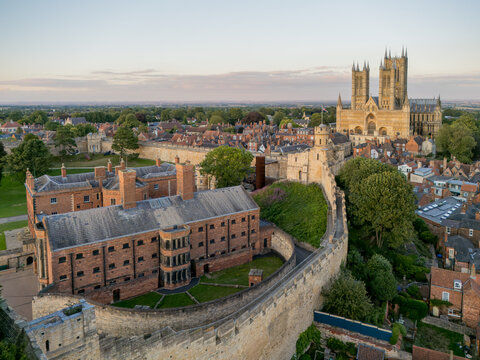
If Hrofescaestir gave this work the wound before Lincoln, this scroll follows the land-and-service corridor that helps explain why Lincoln later becomes such a powerful answer.
The route is not a single bloodline. It is a sequence made from different kinds of historical connection:
William Malet
→ a reconstructed Malet daughter
→ Turold / Thorold, Sheriff of Lincoln
→ Countess Lucy
→ the Earls of Chester
→ Ranulf de Gernon
→ Hugh Bardulf at Waddington
→ Ralph de la Haye
→ Castle Carlton
→ later de la Haye custody at Lincoln Castle through Nicholaa de la Haye.
The value of the corridor lies precisely in keeping blood, land, service, charter witness, folklore, and later family recurrence separate enough to see how they actually meet.
Malet Opens the Norman Field
William Malet stands close to the Conquest gate: Norman lordship, sheriffdom, castles, and the redistribution of English land after 1066.
The proposed bridge from Malet into Lincolnshire rests on a scholarly reconstruction associated especially with Katharine Keats-Rohan. In that reconstruction, Countess Lucy is the daughter of Turold, Sheriff of Lincoln, and an unnamed daughter of William Malet.
The argument draws on charter language, inheritance patterns, and references to antecessores. It is a serious historical reconstruction, but still a reconstruction rather than an uncontested pedigree.
That distinction gives us the first keeper line:
Malet opens the Norman field; Lucy may carry Malet inheritance into Lincolnshire.
Lucy Carries the Lincolnshire Ground
Countess Lucy is the living hinge of the corridor.
She possessed extensive Lincolnshire interests, married into great Anglo-Norman families, became Countess of Chester, and was an important religious patron, especially in the Spalding world.
With Malet we remain close to the Conquest generation. With Lucy, the landscape becomes specifically Lincolnshire: estates, patronage, marriage, and the movement of land into the Chester earldom.
Older traditions have sometimes pulled Lucy and Turold toward Godiva and the surviving Mercian aristocratic field. Those traditions are tangled enough that they should not carry the hard bridge here.
The cleaner handling is:
Godiva — older Mercian recurrence and research question.
Malet — Norman gate.
Turold and Lucy — working historical carrier into Lincolnshire.
Chester Gives the Corridor Force
Lucy's marriage into the Chester world gives the land-stream political weight.
Her son Ranulf de Gernon, Earl of Chester, became one of the major magnates of the Anarchy and was central to the events around Lincoln in 1141.
The Chester earldom was not simply local. Its interests and power crossed Cheshire, Lincolnshire, the Midlands, Wales, and the wider civil-war world of Stephen and Matilda.
The next question is therefore not genealogical but institutional:
How does the Chester service-field reach Hugh Bardulf?
The answer is Waddington.
Waddington: Bardulf Enters the Ground
A charter preserved in The Charters of the Anglo-Norman Earls of Chester records Ranulf II de Gernon granting Hugh Bardulf the demesne of Waddington in Lincolnshire, probably c.1142–46, for the service of three knights. Its witnesses include Ralph de la Haye, William Bardulf, and Hamelin Bardulf.
This is one of the strongest carriers in the scroll.
It places, in one documentary chamber:
Ranulf of Chester,
Hugh Bardulf,
Waddington,
Lincoln,
and Ralph de la Haye, who appears among the witnesses.
The names therefore do not need symbolic glue at this point. The charter places them in the same service-world.
Here the Lucy-Chester inheritance field hardens into land granted for service.
Lucy carries the field into Chester; Chester gives Bardulf the ground.
The Templar Exception
The same Waddington charter explicitly reserves “terra militum sancti Templi Ierussalem” — land of the Knights of the Temple of Jerusalem.
That detail has a precise value. Templar property is already present inside the same local land-field described by the charter. Bardulf’s own relationship to the Order remains a separate question, and the reserved parcel should not be silently equated with Temple Bruer.
The corridor is therefore layered:
noble lordship,
service tenure,
religious and military-order land,
charter witnesses,
and the Lincoln landscape.
That documentary coexistence matters to a wider project already tracking Temple Bruer, Aslackby, Lincoln, and later Templar reception.
Castle Carlton: de la Haye and Bardulf Meet Again
The next important place is Castle Carlton.
The site's manorial history places it after the Conquest with Ansgot of Burwell and then Ralph de la Haye; by the mid-twelfth century, Hugh Bardulf had acquired Carlton from Ralph.
This makes Ralph de la Haye more than a witness hovering at the edge of the Waddington charter. The de la Haye and Bardulf worlds meet again through land transfer.
Now the corridor gains a second physical anchor:
Waddington from Chester.
Carlton from de la Haye.
And at Carlton, later folklore gives Bardulf a dragon.
The Dragon as Landscape Memory
Castle Carlton preserves the legend of Sir Hugh Bardolph and a dragon, including versions in which the creature's vulnerable eye becomes part of the story.
The dragon belongs to folklore, not documentary genealogy. Yet folklore is still evidence of reception: it records how a family name and a place were remembered and mythologised.
The legal corridor gives land, service, and transfer.
The dragon gives the place its mythic skin.
That difference should remain visible. The story need not establish that a historical Bardulf fought a literal monster to matter. It tells us that later memory attached heroic monster-slaying to this ground and name.
In the symbolic register, the result is powerful: the documented knight-service field acquires a legendary beast at the very site where Bardulf and de la Haye land intersect.
de la Haye: From Carlton to Lincoln
The de la Haye name then carries the reader toward Lincoln Castle.
Ralph de la Haye belongs to the mid-twelfth-century Bardulf corridor around Waddington and Castle Carlton.
Nicholaa de la Haye, in the next generations of the family, becomes inseparable from Lincoln Castle through hereditary custody and her defence of the fortress.
The precise kinship and property descent should be followed through charters rather than treated as a symbolic shortcut. But the family field is real enough to give the corridor its final movement:
at one end, de la Haye intersects Bardulf land;
at the other, de la Haye holds Lincoln.
Nicholaa and the Lincoln Answer
In 1217, during the conflict following Magna Carta and King John's death, Nicholaa de la Haye held Lincoln Castle for the young Henry III while William Marshal led the royalist relief.
The Battle of Lincoln became a decisive victory for Henry's government.
Within the wider architecture of the project, this follows the catastrophe at Rochester in 1215. Rochester and Lincoln are distinct campaigns, but the sequence gives the narrative a powerful historical rhythm:
Rochester is wounded under John.
Lincoln holds under Nicholaa.
Marshal arrives.
The child-king's settlement survives.
This scroll explains why Lincoln is more than a convenient symbolic answer. Long before 1217, the land around the city had already carried Malet reconstruction, Lucy's inheritance, Chester power, Bardulf service, Templar property, and de la Haye tenure.
Why the Corridor Matters
Without the corridor, Malet, Lucy, Chester, Bardulf, de la Haye, the Templars, Castle Carlton, and Nicholaa can appear as disconnected names.
Placed in evidential order, they become a chain of different but compatible relationships:
genealogical reconstruction — Malet → Turold → Lucy;
inheritance and marriage — Lucy → Chester;
documented service grant — Ranulf II → Hugh Bardulf at Waddington for three knights;
explicit local reservation — land of the Knights of the Temple of Jerusalem within the same Waddington charter;
witness and land transfer — Ralph de la Haye beside Bardulf;
folklore — Bardulf and the Castle Carlton dragon;
hereditary office and battle — Nicholaa at Lincoln Castle.
That is stronger than pretending every step is the same kind of proof.
The evidence gives the bridges. The landscape gives the resonance.
Keeper Lines
Malet opens the Norman inheritance question.
Lucy carries the Lincolnshire field into Chester.
Chester gives Bardulf Waddington for service.
The Templar exception shows military-order land already inside the same documentary ground.
Ralph de la Haye intersects the Bardulf world again at Castle Carlton.
Castle Carlton gives the later dragon tradition.
Nicholaa de la Haye holds Lincoln.
Rochester is the wound before Lincoln.
Lincoln is the answer after Rochester.
And between them lies a corridor written through inheritance, land, service, charter, castle, and myth.


Comments