
The King, the Daughters, and the Broken Realm

Updated: Aug 20

Alkborough Before the Orders followed the land.
This piece follows the story the land seems to be telling.
In Alkborough Before the Orders, the record did not move like a straight male genealogy. It moved like a braid. Again and again, the ground passed through women:
Godiva carried the old Mercian memory.
Malet’s unnamed daughter carried the hidden Conquest bridge.
Lucy of Bolingbroke carried the Thorold/Malet field into Roumare and Chester.
Muriel of Lincoln carried the Colswain/Picot stream into de la Haye.
Nicholaa de la Haye finally held the castle key.
That pattern is remarkable on its own.
But it becomes even more powerful when placed beside the old British story of King Lear.
Because in Lear, too, the kingdom does not simply pass through sons.
The king has no male heir.
The realm is divided through daughters.
Male authority fails.
Inheritance becomes a test of speech, love, loyalty, and sight.
The land fractures because the king cannot see who truly carries it.
And that story, in its medieval form, comes to us through Geoffrey of Monmouth.
Geoffrey’s Historia Regum Britanniae, or History of the Kings of Britain, was written around 1136, exactly in the generation of King Stephen, Empress Matilda, the Anarchy, Lucy’s sons, and the struggle that would make Lincoln Castle one of the decisive places in England.
That timing matters.
Geoffrey is writing the old kings of Britain while the present kingdom is breaking.
And in the middle of that older British story stands Lear.
The king with daughters.
The king whose realm fractures.
The king who cannot see.
1. Geoffrey writes while England is breaking
Geoffrey of Monmouth’s Historia Regum Britanniae was not written in a calm age.
It belongs to the early twelfth century, around 1136, just after the death of Henry I in 1135 and at the beginning of the struggle between King Stephen and Empress Matilda.
That means Geoffrey’s ancient British kings were not being written into empty space.
They were being written into a kingdom asking:
Who has the right to rule?
Can a woman inherit?
What happens when a king dies without a settled male successor?
What happens when the realm divides?
What happens when oaths break?
What happens when the land itself becomes the battlefield?
Those are not only questions in Geoffrey.
They are the questions of the Anarchy.
They are also the questions beneath Alkborough Before the Orders.
Because in the Lincolnshire corridor, after 1066, we keep seeing the same structure:
male power breaks,
female inheritance carries the land,
the castle becomes the test,
and the realm has to decide who truly holds authority.
That is why Geoffrey belongs here.
He gives the mythic language for the historical pattern.
2. King Lear: the king without sons
In Geoffrey’s story, Lear is an ancient king of Britain.
He has no sons.
His only children are three daughters:
Gonorilla,
Regau,
and Cordeilla.
Later, in Shakespeare’s hands, these names become more familiar as Goneril, Regan, and Cordelia.
The old Lear tradition begins with the king deciding to divide his realm among his daughters. But before he does, he tests them. He asks how much they love him.
The elder daughters flatter him.
The youngest speaks plainly.
The king mistakes flattery for loyalty.
He mistakes truth for insult.
That is the first fracture.
And this is where the symmetry with Alkborough Before the Orders begins.
In the Lincolnshire corridor, the real record is not exactly Lear. Godiva, Lucy, Muriel, and Nicholaa are not Gonorilla, Regau, and Cordeilla. We must not force the figures into the wrong costumes.
But structurally, the chamber is the same.
The question is:
When the male line breaks, who carries the land?
In Lear, the answer is the daughters.
In Alkborough Before the Orders, the answer is also the women.
3. The love-test and the failure of sight
Lear’s tragedy begins with a test.
He asks his daughters to tell him how much they love him.
The two elder daughters speak beautifully and falsely.
Cordelia refuses to perform false language.
In Shakespeare’s later version, this becomes one of the most famous scenes in English drama: a father asks for love to be turned into speech, and the truthful daughter will not corrupt truth into performance.
This is not just family drama.
It is a political and sacred failure.
The king cannot recognise the true carrier.
He gives land to the wrong voices.
He exiles the honest daughter.
He divides the kingdom according to appearance.
That is why Lear is a story of blindness before anyone’s eyes are physically lost.
The king looks at love and does not see it.
He hears loyalty and rejects it.
He hears falsehood and rewards it.
This same symbolic problem runs beneath the Lincolnshire braid.
Because the true carriers in Alkborough Before the Orders are often the least loudly named:
Malet’s daughter is nearly hidden.
Lucy is known, but often treated as a genealogical hinge rather than a force.
Muriel carries a whole Lincoln stream into de la Haye, yet is less famous than the men around her.
Nicholaa becomes visible only when the castle itself must be held.
The male record often names the office.
The women carry the continuity.
Lear asks the wrong question.
The Lincolnshire braid asks the right one:
Not “who boasts of the land?”
But:
who actually carries it?
4. The daughters and the division of Britain
Leir divides Britain through his daughters.
That is the old mythic pattern.
The land is not simply transferred as property.
It is spiritually and politically broken.
A kingdom that should be whole becomes a divided inheritance.
This has a direct symbolic echo with the Anarchy.
After Henry I dies in 1135, Stephen takes the throne, despite Henry having previously named his daughter Matilda as heir.
The result is civil war.
Geoffrey is writing in this same broken atmosphere, and the Lincolnshire families traced in Alkborough Before the Orders are moving inside it.
Lucy’s own inheritance also divides into streams:
William de Roumare carries the Lincolnshire/Bolingbroke estate-current.
Ranulf de Gernon carries the Chester military force.
These are not Lear’s daughters, of course.
But they are Lucy’s divided inheritance streams.
They come from the same mother and then rejoin at Lincoln Castle.
That is the historical mirror.
In Lear:
the king divides the realm through daughters.
In Alkborough Before the Orders:
the Lincolnshire field divides through Lucy’s marriages and sons.
Then the divided field returns to one place:
Lincoln Castle.
That is the key.
The broken realm gathers at the fortress.
5. Cordeilla and the truthful carrier
In Geoffrey’s version, Cordeilla is not simply destroyed at once.
She marries the king of the Franks, returns with military support, restores her father, and later rules Britain herself after Leir’s death.
This is crucial.
Because Shakespeare later makes the story darker, ending in Cordelia’s death.
But Geoffrey’s older Leir story preserves a different shape:
truth rejected,
truth exiled,
truth returns,
truth restores the kingdom,
the daughter rules.
That is powerful for our bridge.
Because it means the female carrier is not just sentimental.
She is political.
She is restorative.
She is sovereign.
Now look back at Alkborough Before the Orders.
Godiva preserves the old sacred land-memory before the Conquest.
Malet’s daughter carries the hidden blood-field into Lucy.
Lucy carries the inheritance into the Anarchy generation.
Muriel carries Colswain/Picot into de la Haye.
Nicholaa physically holds Lincoln Castle.
Each woman is a form of Cordeilla.
Not because they are literally Cordelia.
But because they hold the same symbolic office:
the rejected or under-seen female carrier of continuity.
The men often fight over the kingdom.
The women carry its memory.
6. Godiva as the mercy before the fall
Godiva stands before the Norman fracture like a pre-Lear figure.
She is the old female presence attached to land, mercy, patronage, and sacred giving.
In the later legend, Godiva rides through Coventry to relieve the people from oppressive taxation. Whether that legend is literal history is not the point here.
Symbolically, she is remembered as the woman whose body, humility, and mercy stand between lordship and suffering.
That matters because Lear begins when lordship has lost humility.
A king wants love performed for him.
Godiva’s symbolic world is almost the opposite:
mercy over pride,
sacred patronage over display,
intercession between power and people.
So in our symmetry, Godiva is not one of Lear’s daughters.
She is the lost quality that Lear lacks.
She is the mercy before the fall.
She stands for the old sacred relation between land, ruler, people, and gift.
Then Harold falls.
Malet receives the body.
The kingdom changes hands.
The old mercy-world becomes memory.
7. Malet’s daughter as the hidden Cordelia-thread
The most haunting figure in the whole Alkborough Before the Orders pattern may be Malet’s unnamed daughter.
If Lucy is indeed the daughter of Thorold/Turold by a daughter of William Malet, then Malet’s line enters the Lincolnshire braid through a woman whose name is almost swallowed by the record.
That is pure Lear-symbolism.
The daughter who matters most is not the one loudly enthroned at the beginning.
She is the one through whom the truth continues.
In Lear, Cordelia refuses false speech and is cast out.
In our historical braid, Malet’s daughter is not cast out in the story, but she is nearly cast out by the record itself.
She becomes a hidden passage.
And yet, through her, the Malet field reaches Lucy.
Through Lucy, it reaches Roumare and Chester.
Through Roumare and Chester, it reaches Lincoln Castle.
That means the almost-unnamed woman may be one of the most important carriers in the whole structure.
This is why the bridge keeps returning to the hidden female line.
Not because it is decorative.
Because the visible male record sometimes hides the true mechanism.
8. Lucy as the divided kingdom in one woman
Lucy of Bolingbroke is where the Lear symmetry becomes strongest.
She is not merely an heiress.
She is a chamber.
Through her, several fields meet:
Thorold’s sacred Lincolnshire custody.
Malet’s Conquest manor and Harold-body hinge.
Ivo’s Domesday and Peterborough route.
Roumare’s estate current.
Chester’s military force.
She is almost a kingdom divided into marriages.
Her life produces multiple streams, and those streams later act upon the national crisis.
This is exactly why she belongs beside Lear.
Lear divides his kingdom among daughters.
Lucy’s marriages divide and distribute the Lincolnshire inheritance into sons and powers.
But the deeper symmetry is this:
In Lear, the father divides the realm badly because he cannot see.
In Lucy, the land divides through marriage and inheritance, but the streams later reveal the hidden unity beneath them.
William de Roumare and Ranulf de Gernon are half-brothers.
They come from Lucy.
When they seize Lincoln Castle, Lucy’s divided streams become one force.
So Lucy is not merely part of the story.
She is the loom.
9. Lincoln Castle as the Lear-stage
In Shakespeare, Lear’s kingdom becomes a storm-stage.
The land itself seems to answer the broken order.
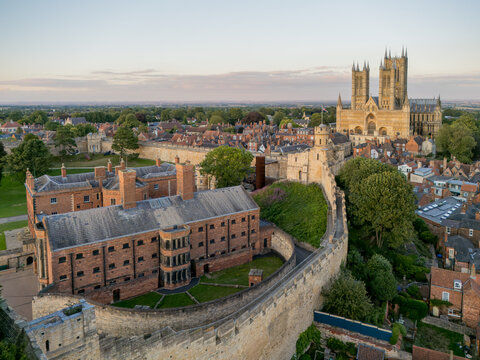
In the Lincolnshire record, the equivalent stage is Lincoln Castle.
This is where the divided streams gather.
William de Roumare and Ranulf de Gernon seize the castle.
Stephen comes against them.
The conflict draws in Matilda’s cause.
The king is captured.
England’s broken succession becomes visible at Lincoln.
That is a Lear moment.
A king’s authority is stripped.
The realm is unstable.
Family, oath, land, and legitimacy are all under judgement.
And again, beneath the male battle is the female inheritance pattern:
Lucy’s sons fight because Lucy’s line gave them the ground from which to act.
The castle-stage is built from female-carried land.
10. Muriel of Lincoln: the second hidden daughter
If Lucy is one half of the Lear symmetry, Muriel of Lincoln is the other.
Muriel carries the Colswain/Picot stream into de la Haye.
This is not the loudest part of the story, but it may be one of the most important.
Because without Muriel, de la Haye risks looking like a later arrival placed over the castle from above.
With Muriel, de la Haye becomes rooted in an older Lincolnshire land stream.
That mirrors Lucy.
Lucy carries Thorold/Malet into Roumare/Chester.
Muriel carries Colswain/Picot into de la Haye.
Two women.
Two streams.
One castle.
In Lear terms, Muriel is another hidden Cordelia-thread: the woman through whom the truthful inheritance moves quietly.
She is not standing on the stage declaring herself.
But without her, the later office does not carry the same depth.
11. Nicholaa de la Haye: Cordelia with the castle key
Nicholaa de la Haye is where the symbolic chamber becomes visible.
She is the woman who holds Lincoln Castle.
In the Lear pattern, Cordelia is the daughter who returns with force to restore the father and kingdom in Geoffrey’s older version. In Shakespeare’s darker version, she returns but dies, and the kingdom collapses into tragedy.
But either way, Cordelia is the daughter whose truth exposes the false order.
Nicholaa is not Cordelia.
But she stands in the same chamber.
She is the female holder of the fortress at the moment of crisis.
She does not merely carry memory.
She acts.
She defends.
She holds.
In Alkborough Before the Orders, the sequence is:
Godiva gives the old mercy-memory.
Malet’s daughter carries the hidden bridge.
Lucy carries the divided inheritance.
Muriel carries the parallel land-stream.
Nicholaa holds the castle key.
That is an astonishing progression.
It is almost as if the Cordelia principle becomes more visible each time.
First memory.
Then hidden descent.
Then inheritance.
Then land transfer.
Then castle custody.
By Nicholaa, the hidden daughter-thread has become a woman with the keys in her hand.
12. Geoffrey, Arthur, and the British king-list
Geoffrey’s Historia does more than preserve the Leir story.
It also gives medieval Britain one of its great mythic sequences:
Brutus.
The early kings.
Leir.
Cymbeline.
Arthur.
Merlin.
The long drama of Britain before the Saxons.
That matters for the wider bridge.
Because Lear is not an isolated tale.
He sits inside the same mythic British history that leads toward Arthur.
So when we connect Alkborough Before the Orders to Lear, we are also opening the road toward Arthurian Britain.
That does not mean Geoffrey is giving us literal history.
It means Geoffrey is giving the medieval imagination a structure:
Britain as sacred island.
Britain as inherited realm.
Britain as broken kingdom.
Britain as land carried through betrayal, exile, restoration, and prophecy.
This is why Geoffrey belongs beside Alkborough.
Alkborough Before the Orders gave us the land-pattern.
Geoffrey gives us the story-pattern.
Both ask the same question:
Who carries Britain when kings fail?
13. Shakespeare’s Lear: the old story returns darker
Centuries later, Shakespeare takes the old Leir story and turns it into King Lear.
The old story returns, but darker.
In Geoffrey, Cordeilla returns, restores her father, and rules.
In Shakespeare, Cordelia returns too, but the ending is tragedy.
The daughter of truth is not rewarded with a peaceful restoration.
She dies.
The father dies.
The kingdom survives only through ruin.
That shift matters.
It tells us that by Shakespeare’s age, the old British inheritance story had become more haunted.
The question is no longer simply:
Can the truthful daughter restore the realm?
It becomes:
What happens when the world is too broken to recognise truth even when it returns?
This darker Lear belongs to the later part of the bridge.
By the time Shakespeare writes, the story has moved through Reformation, monarchy, martyrdom, hidden religion, craft identity, print culture, and the strange world of Thomas Deloney and The Gentle Craft.
So Shakespeare’s Lear does not close the pattern.
It darkens it.
It prepares the next doorway.
14. The symmetry table
Here is the core symmetry between Alkborough Before the Orders and King Lear.
In Lear
A king has no son.
In Alkborough Before the Orders
The decisive continuity does not move cleanly through obvious male succession. It keeps passing through women.
In Lear
The kingdom is divided through daughters.
In Alkborough Before the Orders
The Lincolnshire field divides through female inheritance and marriage: Godiva’s descendant line, Malet’s daughter, Lucy’s marriages, Muriel’s transfer into de la Haye.
In Lear
The true daughter is hidden by plain speech.
In Alkborough Before the Orders
The true carriers are often hidden by the record: Malet’s daughter, Lucy’s maternal line, Muriel’s role beneath de la Haye.
In Lear
The king cannot see who loves him truly.
In Alkborough Before the Orders
The surface record can make us miss who actually carries the land.
In Lear
The broken kingdom becomes a battlefield.
In Alkborough Before the Orders
The broken kingdom becomes visible at Lincoln Castle in the Anarchy.
In Geoffrey’s Leir
Cordeilla returns and restores the kingdom.
In Alkborough Before the Orders
The female thread returns as custody: Lucy carries, Muriel transfers, Nicholaa holds.
In Shakespeare’s Lear
The story becomes tragedy, blindness, storm, and judgement.
In Alkborough Before the Orders
The landscape becomes witness: castle, church, well, maze, carvings, and heart-tree.
15. The deeper meaning
The Lear symmetry does not mean that Geoffrey was secretly writing about Thorold, Malet, Lucy, Muriel, or de la Haye.
That would be too blunt.
The deeper point is better.
The same symbolic grammar appears in both places.
In the record:
A kingdom falls.
Land changes hands.
Male power fractures.
Women carry continuity.
The castle becomes the test.
The Orders arrive into already-charged ground.
In the story:
A king fails.
The realm divides.
Male sight collapses.
Daughters carry the fate of the kingdom.
Truth is exiled.
The land suffers until right seeing returns.
That is the symmetry.
Not one-to-one identity.
A shared chamber.
The women of Alkborough Before the Orders stand in that chamber.
Godiva.
Malet’s daughter.
Lucy.
Muriel.
Nicholaa.
They are not Lear’s daughters.
But they answer Lear’s question.
Who truly carries the kingdom?
Not always the man with the crown.
Sometimes the woman with the land.
Sometimes the daughter without a name.
Sometimes the heiress behind the office.
Sometimes the widow with the castle key.
Closing reflection: the daughters beneath the castle
Alkborough Before the Orders ended with the ground already sacred.
The King, the Daughters, and the Broken Realm ends with the story already present.
Before the Templars arrived, the land had already passed through women.
Before the Orders came into Lincolnshire, the old British story had already taught that kingdoms fracture when fathers cannot see daughters clearly.
Before Shakespeare darkened Lear into tragedy, Geoffrey had already placed Leir inside the ancient king-list of Britain.
And before Nicholaa de la Haye held Lincoln Castle, the pattern had already been moving:
Godiva as mercy.
Malet’s daughter as hidden bridge.
Lucy as inheritance.
Muriel as transfer.
Nicholaa as custody.
This is the symmetry.
Lear asks for love and loses the realm.
The Lincolnshire braid asks for witness and reveals the carriers.
The king breaks the land by misreading his daughters.
The land heals its memory by making us look again at the women.
So the next doorway opens:
from Alkborough to Geoffrey,
from Geoffrey to Lear,
from Lear to Shakespeare,
from Shakespeare to Stephen,
from Stephen to the maker’s craft.
The king falls.
The daughters carry.
The castle waits.
The story does not die.


Comments