
The Printed Sky and the Disclosure Mirror

Updated: Aug 20
There are moments when the sky enters history.
It becomes report, warning, testimony, theology, fear, science, image, argument, ridicule, wonder, and doubt.
Nuremberg in 1561 was one such moment.
Fátima in 1917 became another.
The modern “disclosure” age gives the same human problem a new vessel: clips, sensors, hearings, leaks, podcasts, documentaries, screenshots, memes, sceptical threads, official language, AI summaries, and the infinite feed.
The vessel changes.
The moral problem remains:
What was seen? Who recorded it? What did the recorder add? What did fear, faith, power, and expectation do to the interpretation?
This scroll is not a verdict on UFOs, apparitions, atmospheric optics, angels, aliens, or state secrecy.
It is about how to look without lying for what we want to see.
That discipline belongs near the doorway of The Gentle Third Craft because the same rule governs a broadsheet, a tree mark, a family recurrence, a medieval chronicle, a well, or a modern video.
The event is one thing.
Its record is another.
Its interpretation is another again.
The Renaissance Eye
Before Nuremberg's sky entered print, Europe had already begun changing the way it looked.
Renaissance culture recovered ancient texts, developed perspective, expanded cartography, intensified anatomical study, transformed astronomy, and multiplied books through print.
Geometry reshaped representation.
Maps became instruments of authority.
Books became travelling vessels.
The world seemed increasingly readable.
But an opened eye does not encounter only order. It also sees things it cannot immediately classify.
That is where the Nuremberg broadsheet belongs: between the older world of omen and the newer culture of observation and print.
Hans Glaser and the Printed Sky
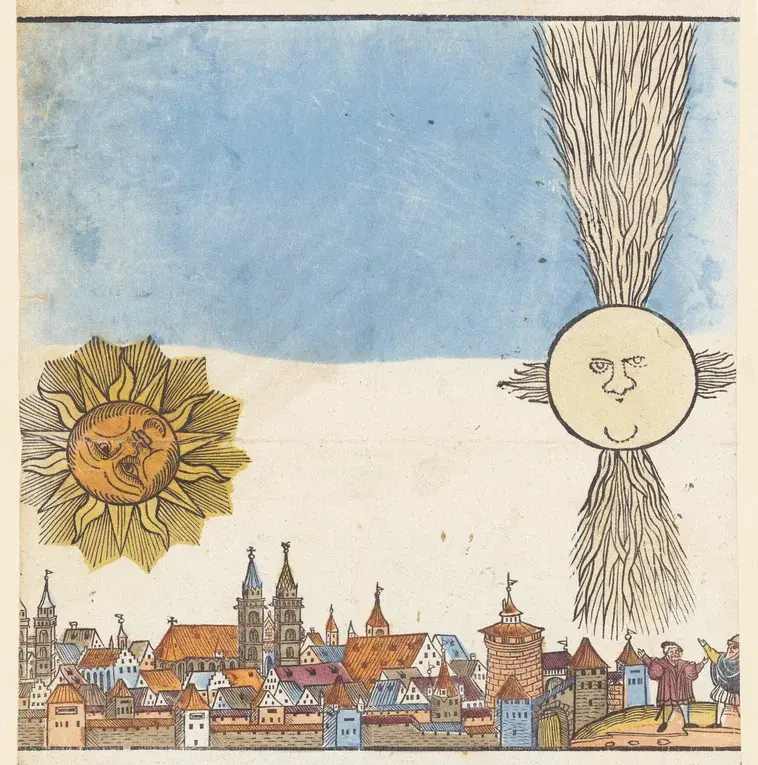
A coloured broadsheet by Hans Glaser, printed in Nuremberg in 1561 and now preserved in Zürich, describes a strange celestial display reportedly seen around dawn on 14 April 1561.
Its text speaks of coloured arcs, globes, crosses, rods, cylindrical forms, movement around the sun, objects appearing to fall, and smoke. The woodcut gives those reported forms a vivid visual body.
The most important fact for this scroll is not that one modern interpretation must win.
It is that Glaser turned a reported sky-event into a reproducible object.
Witness became woodcut.
Experience became text.
The sky became print.
That act preserves the report, but it also frames it. Glaser's own text interprets the phenomenon within a Christian moral universe, as a warning calling people toward repentance.
So the broadsheet is both source and interpretation.
That is the first lesson of the scroll:
the record preserves the event as reported, but the record is not the sky itself.
Cross, Geometry, and Mechanism
Modern viewers often notice how strangely hybrid the image feels.
Crosses and solar forms sit beside rods, spheres, tubes, and a dark spear-like shape. To a sixteenth-century reader, the whole scene could live inside the grammar of divine warning. To a twentieth- or twenty-first-century UFO reader, some forms can look mechanical. To a sceptical atmospheric reading, the report invites comparison with halos, parhelia, and other optical phenomena.
The image therefore becomes a disclosure mirror: every age sees not only Glaser's sky, but its own available language for the unknown.
Religious omen.
Atmospheric event.
Aerial battle.
Psychological projection.
Extraterrestrial machinery.
Printed moral theatre.
The source can be studied without pretending that the interpretation is settled.
England Learns to Watch
Nuremberg's broadsheet belongs to the same broad sixteenth-century world in which England was struggling with Reformation, succession, espionage, navigation, print, confessional allegiance, and the problem of how a state reads danger.
In 1561 Elizabeth I's settlement was still young, Mary Queen of Scots had returned to Scotland, and the future succession remained unsettled.
John Dee, Henry Billingsley, and Stephen Slaney belong to that English culture of interpretation in different ways.
They were not witnesses beneath Glaser's sky.
Their relevance is structural.
Dee worked at the intersection of mathematics, astronomy, astrology, navigation, calendar reform, empire, and later angelic practice.
Billingsley translated Euclid into English, with Dee's Mathematicall Praeface framing the mathematical arts.
Slaney moved through merchant company, sheriffdom, mayoralty, civic government, trade, land, and the practical watchfulness of the city.
The bridge is therefore:
Glaser prints the sign.
Dee seeks order.
Billingsley translates measure.
Slaney enters civic watch.
No conspiracy is required. These men simply show how the age was learning to convert uncertainty into image, number, map, office, record, and policy.
From Omen to Data
The Enlightenment and the rise of modern science changed the sky again.
Light became optics.
Weather became atmosphere.
Motion became law.
Strange appearance became something that could be measured, compared, reproduced, or explained through natural mechanisms.
That intellectual shift was a gift. It weakened the power of fear to turn every unusual sight into supernatural certainty.
But measurement introduced its own temptation: to confuse explanation with ownership.
This is where the neighbouring well / jar / Frankenstein argument matters.
The well is living source in landscape.
The laboratory vessel isolates and studies.
Both can teach.
The ethical failure comes when the maker believes that because something can be opened, measured, or animated, it has therefore been understood or loved.
The same warning applies to the sky.
A report is a vessel.
A theory is a vessel.
Footage is a vessel.
None is the whole phenomenon.
Fátima: The Sun Becomes Testimony
In 1917, amid war and political tension in Portugal, three children at Fátima reported Marian apparitions. A large crowd gathered at the Cova da Iria on 13 October after a sign had been expected.
Many witnesses later described an extraordinary solar phenomenon—movement, changing colours, rotation, or the impression that the sun approached the earth. Accounts varied, and not everyone reported the same experience.
The Catholic Church later accepted the apparitions as worthy of belief, while sceptical explanations have invoked optical, meteorological, psychological, and expectation effects.
Fátima belongs beside Nuremberg not because one proves the other, but because both show how a public sky-event enters a wounded culture through testimony, media, authority, faith, and dispute.
At Nuremberg, the sky becomes broadsheet.
At Fátima, the sun becomes mass testimony and newspaper event.
The twentieth century changes the vessel again.
The Disclosure Mirror
Today the vessel is the feed.
A strange light or sensor contact can move from military system to leaked image, official report, television panel, congressional or parliamentary discussion, podcast, short clip, debunk, counter-debunk, meme, and algorithmic recommendation in hours.
Speed changes the psychology of witness.
A sincere witness can be mistaken.
A real image can be interpreted wrongly.
A sceptic can become closed before examining the material.
A believer can become so hungry for confirmation that uncertainty feels intolerable.
An institution can release information while still controlling how it is framed.
A filmmaker can awaken wonder while shaping desire.
The modern disclosure debate therefore reveals more than what may or may not be in the sky.
It reveals what people want the sky to mean.
Salvation.
Threat.
Proof.
New religion.
State confession.
Scientific discovery.
Spiritual enlargement.
Ridicule.
Power.
The feed is not a neutral vessel any more than Glaser's broadsheet was.
Faith Under a Wider Sky
The possibility of a universe larger or stranger than inherited imagination raises genuine theological questions.
But faith need not become brittle simply because the cosmos grows.
Nor does scientific caution require mockery.
The harder discipline is to remain open enough to examine and grounded enough to resist appetite.
Look.
Test.
Record.
Compare.
Ask what the source can actually carry.
Leave room for wonder.
Leave room for error.
That is not indecision. It is the difference between witness and possession.
Why This Scroll Stands Near the Door
The method here applies directly to the rest of the project.
Glaser's broadsheet is not identical with the event it describes.
A photograph of a tree mark is not identical with its maker's intention.
A symbolic name recurrence is not a parish register.
A family tradition is not automatically genealogy.
A well is not a doctrine.
A personal field experience is not a universal law.
Yet each can still be valuable when held in its proper register.
That is why the project now distinguishes:
Secure Record.
Strong Synthesis.
Working Hypothesis.
Symbolic Recurrence.
Field Witness.
The purpose is not to make mystery smaller.
It is to keep the vessel clean enough that mystery and evidence are not confused with one another.
Thomas and the Wrong Eye
The scroll finally returns to the ethics of seeing.
Peeping Tom looks because he wants access to what has been withheld.
Thomas the Apostle asks to touch the wound because second-hand certainty is insufficient.
One becomes the wrong witness.
The other becomes the tester.
That is the choice facing every reader of a charged source.
Not hunger dressed as revelation.
Not ridicule dressed as intelligence.
Not ego dressed as destiny.
Witness.
Restraint.
Reverence.
Attention.
The Renaissance reopened the eye.
Nuremberg put the sky into print.
Dee and Billingsley helped turn wonder toward measure.
Slaney belonged to the watched and guarded city.
The Enlightenment raised the lamp of reason.
Fátima turned the sun into contested public testimony.
The modern feed turns disclosure into continuous interpretation.
And beneath every vessel remains the older question:
When the world gives us a sign, what kind of witness do we become?


Comments