
From Broken Temple to Bloxwich

Updated: Aug 20
There comes a point in a family search where the record stops behaving like a straight road and becomes a field.
That point, for the Slaney enquiry, is Stephen Slaney.
His own life is unusually visible: London merchant and civic officer, Rochester/Kent legal business, Alkborough land, and Humber fishery. Behind him, however, the direct parentage route is still less secure than the surrounding landscape of names, estates, churches, offices, and later Slaney branches.
The useful question is therefore not yet, Who proves the hidden ancestor?
It is:
What historical field gathers around the line before and after Stephen?
That field reaches through Lincoln, Temple Bruer, Coventry and Lichfield, Enville, Bloxwich, Walsall, Shifnal, Hatton Grange, Rochester, Alkborough, and the Lany cathedral route.
Where the genealogy thins, the landscape thickens.
Nicholaa de la Haye: Custody Before the Temple Wound
The strongest de la Haye figure in the project remains Nicholaa de la Haye.
Her hereditary constableship and defence of Lincoln Castle belong to secure medieval history. She gives the name a concrete function before later speculative routes begin:
custody.
Castle, gate, office, land, defence.
This matters because later de la Haye references appear around the redistribution or administration of troubled lands. The family name cannot be treated as one continuous secret office, but Nicholaa gives the project a genuine medieval benchmark for what “custody” actually looked like.
William de la More and the English Temple
A century later, William de la More carries a different form of custody.
As one of the senior leaders of the Knights Templar in England, he was caught in the suppression of the order and died in confinement in 1312. His English route includes Temple Bruer, one of the major Lincolnshire Templar estates.
The contrast with Jacques de Molay is historical rather than genealogical:
William de la More — English Templar leadership, arrest, imprisonment, death in confinement.
Jacques de Molay — Grand Master, trial, and execution in Paris in 1314.
The two men belong to the same institutional collapse.
The English wound therefore has a Lincolnshire face.
John de la Haye and the Broken-Land Question
A John de la Haye appears in material associated with royal administration after major confiscations, including routes connected with former Templar property and lands affected by the fall of Walter Langton, Bishop of Coventry and Lichfield.
This is a promising but source-sensitive bridge. It should remain tied to the specific accounts and commissions rather than turned into a general claim that “de la Haye inherited the Temple.”
Its importance is functional:
after institutional collapse, someone must inventory, hold, account for, transfer, or restore land.
That is the world in which John de la Haye becomes relevant.
And Walter Langton opens the route toward the Coventry–Lichfield–Staffordshire church-land field.
Staffordshire: The Landscape Behind the Slaney Mist
The wider Slaney material repeatedly returns to Staffordshire and its border country:
Bloxwich,
Walsall,
Yardley,
Mitton,
Shifnal,
Hatton Grange,
Bescot,
Brocton,
Enville.
These places do not yet form a single direct pedigree back from Stephen. Some belong to later Slaney branches, collateral material, marriage networks, or landholding that must be reconciled generation by generation.
But they give the enquiry a real regional field rather than an empty gap.
Enville: Arthurian Carving and the Templar Question
St Mary the Virgin, Enville sits inside that Staffordshire/Shropshire border-world.
Medieval grave slabs there have been discussed in modern local and heritage contexts as possibly Templar-related. The attribution is intriguing but remains a Templar question, not confirmed Templar burial evidence.
The church also preserves medieval imagery that has been interpreted in Arthurian terms, including material associated with Yvain / Owain.
That gives Enville two distinct layers:
possible military-order reception around the graves;
Arthurian church imagery within the medieval building.
Neither proves Slaney ancestry.
But Enville establishes that the Staffordshire field later occupied by Slaney families already carried medieval religious and Arthurian memory.
Lincoln gives Arthur through Tennyson and later national reception.
Enville gives an older carved or painted church-world.
The two belong to different centuries, but they place Arthur at both ends of the regional route.
Bloxwich and Walsall: Slaney in the Ground
The later Slaney field is strongest when it moves from names into property.
Genealogical material connects Slaney branches with Bloxwich and Walsall, while later deeds and manorial histories place Slaney holders inside the local land system.
At Bescot, the Mountfort/Harris descent enters the Slaney family through marriage with Jonas Slaney, and later Slaneys are associated with the manor.
Other records place Walsall and Bloxwich property in Slaney hands in the early modern and eighteenth-century field.
This does not solve Stephen's parentage.
It does establish that the surname is genuinely rooted in the Staffordshire land-world that the enquiry keeps returning to.
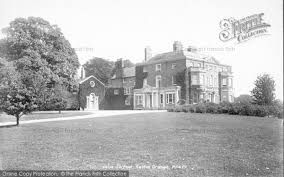
Hatton Grange: Former Abbey Land
Hatton Grange adds another concrete layer.
The estate had belonged to Buildwas Abbey before the Dissolution. In the seventeenth century, Robert Slaney acquired Hatton Grange.
That is a secure kind of continuity to record carefully:
former monastic land later entering a Slaney estate.
It does not make the Slaneys heirs to a suppressed religious order in any secret sense.
It demonstrates something more ordinary and historically useful: after the Reformation, land that had once served an abbey moved into gentry and private ownership, and a Slaney branch became one of those later custodians.
For a project concerned with what happens to sacred and institutional land after dissolution, Hatton Grange is a valuable carrier.
Moreton of Brocton Grange
The same Staffordshire branch brings in Anne Moreton, daughter of Thomas Moreton of Brocton Grange, through marriage with Robert Slaney of Hatton Grange.
The name naturally catches the ear beside de la More and Moreton Corbet, but it must remain its own surname and family until genealogy says otherwise.
Its present value is as a real Staffordshire gentry connection inside the Slaney network.
The research question is therefore not Does Moreton equal de la More?
It is What legal, landed, and kinship networks surrounded the Moretons of Brocton and the Slaneys of Hatton?
That is an archive route capable of producing evidence.
Stephen Slaney: Rochester and Alkborough
Stephen himself then gives the field its strongest long-distance carrier.
His documented activity connects him with Rochester, Chatham, and Horsted through Kentish land or trust arrangements, and with Staynton and Awkborough / Alkborough through the 1560s transaction that included a free fishery in the Humber.
This is why Stephen remains the gate.
He joins London civic life to land on both sides of the country.
Rochester becomes a Kent hinge.
Alkborough returns the family to the Humber landscape where the modern story later opened.
No symbolic claim is needed to make that remarkable.
Lany / Laney: The Parallel Church Route
The Lany / Laney material should remain beside Slaney without being collapsed into it.
Benjamin Laney carries a Restoration church route through Rochester, Peterborough, Lincoln, and Ely.
Thomas Lany separately appears as Precentor of Lincoln Cathedral.
Slaney's route is mercantile, civic, legal, and landed.
Lany's surviving route is ecclesiastical and musical.
Rochester becomes the most interesting shared place-name in the two histories, but shared geography is not yet shared genealogy.
The question remains open for records.
Deloney, Dekker, and the Third Craft
The route then changes medium.
Thomas Deloney and Thomas Dekker belong not to castle or cathedral custody but to the world of craft, city, print, theatre, and the dignity of ordinary making.
Stephen Slaney belonged to the same broad Elizabethan civic London in which Deloney wrote, and Slaney's intervention against Deloney's grain ballad gives the two men an actual historical point of contact.
That makes the later literary sequence especially valuable:
Deloney writes The Gentle Craft.
Dekker carries its shoemaker world into The Shoemaker's Holiday.
The keeper-function has changed vessel again—from land and office into story.
Thomas Slaney, Stephen's son who died without continuing the direct line, remains a separate personal and symbolic recurrence inside that chamber. His importance should not be inflated into a hidden Deloney identity; the archival task is to recover as much of his actual life as possible.
The stronger insight is transmission:
what institutions cannot carry forever may survive through land;
what land cannot explain may survive through office;
what office cannot preserve may survive through story and craft.
The Mist Beyond Stephen
The genealogy currently reaches a point where certainty and possibility must be separated.
Stephen Slaney is secure.
The wider Staffordshire Slaney world is real.
Specific later Slaney holdings at Bescot and Hatton Grange are real.
The Rochester and Alkborough carriers are real.
What remains unresolved is the exact documentary path that joins Stephen backward into the wider Staffordshire material and, beyond that, any medieval family line.
That is the Mist Beyond Stephen.
The mist is not permission to invent.
It is a research zone containing identifiable archives, places, families, and land histories.
The method is therefore simple:
one hand on the record;
one hand on the open route.
The Custody Field
The whole scroll can now be held without repeating the same conclusion at every stage.
Secure carriers:
Nicholaa de la Haye at Lincoln Castle.
William de la More in the English Templar suppression and Temple Bruer field.
Slaney landholding in Staffordshire branches.
Hatton Grange as former Buildwas Abbey land later held by Robert Slaney.
Stephen Slaney's Rochester/Kent and Alkborough/Humber routes.
Benjamin Laney's cathedral career and Thomas Lany's Lincoln office.
Slaney's real civic contact with Deloney.
Working routes:
Open work: the exact John de la Haye / former Templar / Walter Langton administrative bridge; the genealogical carrier from Stephen into the wider Staffordshire Slaney field; and any deeper kinship between Moreton, de la More, Slaney and Lany.
Reception and symbolic recurrence:
Symbolic and reception layer: Enville’s Templar-grave tradition; Arthurian imagery in the Staffordshire field; and the repeated custody-functions of castle, Temple, church, land and craft.
That is enough for the scroll.
The bridge from broken Temple to Bloxwich is not yet one bloodline.
It is already something historically visible:
a landscape of custody, dissolution, land transfer, family holding, civic office, church memory, and craft.
Where the genealogy thins, the landscape thickens—and the next task is to find the record that lets one part of that landscape become genealogy.


Comments