
WHERE THE RIVERS MEET

From the Alkborough Fine to London Stone, Beli Mawr and Anna
I. THE NAME WRITTEN BESIDE THE WATER
Begin at Alkborough, where the river and the written record meet.
Below the Lincolnshire height, the Trent and Ouse meet and become the Humber. Above them a parish church, a turf maze and a medieval earthwork keep watch over a country whose history has been written in too many hands to belong to any single one.
In Trinity term 1568, one of those hands belonged to Stephen Slanye.
A later royal patent, dated 4 March 1569, records a pardon for alienation arising from a fine between Thomas, Lord Wentworth, and his wife Anne, and Wolstan Dixie and Stephen Slanye. It names the manors of Awkborough and Staynton, associated land, and a free fishery in the waters of the Humber. The interest was directed to Dixie and his heirs.
There is our opening: a named London merchant entering the surviving legal record of Alkborough and its river rights. His name takes us into a wider company of families, estates, courts and inherited stories.
Stephen's position merits a closer look. Two years earlier, in 1566, he had appeared alongside Francis Barnham in another Wentworth property instrument, this time involving land in Kent and the management of Wentworth's interests. By 1568 his name had entered a transaction involving two Lincolnshire manors and a fishery on the Humber. The royal pardon preserves the names, properties and legal occasion. The original Common Pleas concord is the next document that can tell us more about the interests and responsibilities of those named.
The name is there. The manors are there. The Humber fishery is there. We start with what the document actually placed together.
II. WHAT THE HILL REMEMBERS
Long before Slanye appeared in its papers, Alkborough had gathered the traces of earlier families and institutions. Their history still rests in the landscape.
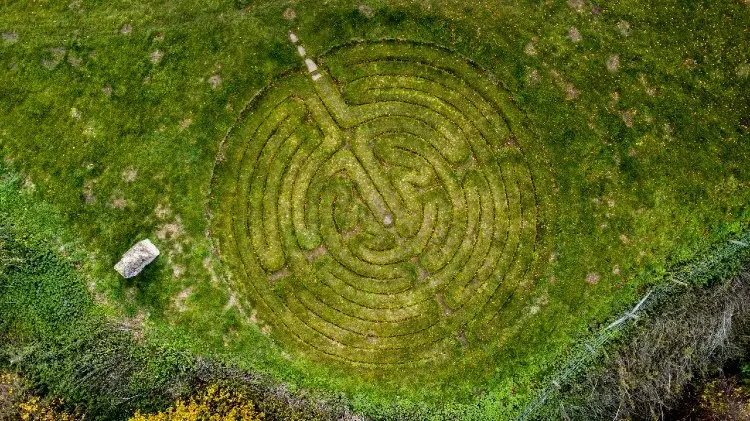
The turf labyrinth called Julian's Bower lies above the water: one path folding through eleven rings, drawing the walker steadily towards its centre. Historic England protects it as a rare medieval monument, and Abraham de la Pryme described it in 1697. A possible connection with the religious community of Spalding Priory adds another chapter to its history. In 1887, its pattern was copied into the porch of St John the Baptist, giving the design a second home in stone.
Beside it is Countess Close, a medieval moated manor site with traces of buildings beneath the turf. Its name has long been associated with Countess Lucy, one of the great women of the Norman and early Angevin landscape. The earthwork, the name and Lucy's documented regional interests invite us to follow the surviving deeds more closely.
The old parish church, the monastic claims, Kell Well, Romano-British finds and the vantage above Trent Falls belong to one extraordinary historic landscape. Each has its own history; together they make Alkborough a compelling place to study how land, memory and ceremony moved through the centuries.
Even the maze's name opens a door into story. Local heritage records connect Julian or Julus with Iulus, son of Aeneas, and with the traditions of Troy-town labyrinths. Through that remembered name we reach Brutus, the legendary descendant of Troy who gives Britain its foundation story in medieval historical writing. The maze belongs to the lived landscape; the Trojan tradition belongs to the history of how Britain imagined its beginnings. At Alkborough the two can be read together.
III. HAROLD, MALET, LUCY — THE CONQUEST LANDSCAPE
The Domesday survey offers firmer names. At Alkborough one holding had belonged in 1066 to William Malet. By 1086 Ivo Taillebois held it. A different Alkborough holding had been Eskil's, with Peterborough Abbey and Ivo appearing in the post-Conquest arrangement. The survey therefore preserves two distinct landholding histories within the same village.
Malet stands at the heart of the Norman Conquest and the story of Harold Godwinson's defeat. Later chroniclers associate him with the handling of Harold's body after Hastings, a tradition that gives his name an additional place in the memory of 1066. Domesday then anchors his lordship directly at Alkborough.
Harold's own land interest brings us to nearby West Halton, whose wider soke reached towards Walcot and neighbouring places. Archaeological historians describe the West Halton–Alkborough promontory as strategically important: the Trent to one side, the Humber ahead, and northern and midland routes within reach. Harold's estate and Malet's Alkborough holding occupy the same remarkable stretch of land and water.
Ivo's marriage to Lucy takes us into the inheritance of a remarkable woman. Research on the Malets and the family charters of Spalding reconstructs Lucy as a descendant of William Malet through Turold and a Malet daughter. Lucy married Ivo Taillebois, bringing her household into the same world of Lincolnshire estates, religious benefactions and succession. At Alkborough, Countess Close preserves a name that invites us to bring the family documents back to the earthwork.
Here are Harold, Malet, Eskil, Ivo, Lucy, Peterborough and Spalding: named owners, neighbours, monastic institutions and a family reconstructed from land and marriage. The story of Alkborough begins to look like a passage through divided inheritance rather than the possession of one unbroken house.
IV. DESPENSER, GREY, BEAUCHAMP AND WENTWORTH
A legal instrument dated 24 June 1294 places the manor of Alkborough in a grant by Hugh le Despenser the Elder to his son Philip. The precise medieval succession matters because another Alkborough manor appears in a 1406 settlement recited in a 1424 inquisition: Philip le Despenser's estate passed toward his daughter Margery, wife of Roger Wentworth. This Despenser–Wentworth road leads toward later Wentworth holdings and eventually Thomas Wentworth, the vendor of 1568.
Beside the Despenser–Wentworth manor runs a second landholding road, with its own surviving deeds and its own distinguished families.
On 25 November 1391 Reynold de Grey of Ruthin entered into a great final concord, later also marked in 1400. Among its many properties were ten messuages, two carucates of land, twenty acres of meadow and a rent distributed across Donington, Waddington, Goulceby and Alkebarewe. The published legal abstract says it was made by command of the king. In 1400 the same property quantities recur in Grey's inquisition; in 1411 they are described in the estate of William de Beauchamp, Lord Bergavenny, and his wife Joan. Named feoffees provide the mechanism by which the property was conveyed.
Grey's lands and the Despenser manor survive in different legal descriptions and under different overlord relationships. Their relationship is a precise historical question: which parcels lay beside one another, which rights overlapped, and what happened to each holding as the families changed?
The named people bring the two documentary worlds into sharper focus. Adam of Usk, the Welsh lawyer and chronicler, represented the same Grey of Ruthin in the great 1401 Grey–Hastings heraldic dispute. William Beauchamp supported Grey, since a Hastings inheritance contest affected his own interests. Adam also wrote about William's wife Joan FitzAlan. The chronicler who lived amid those legal families also preserved Mortimer genealogy and the Welsh political world.
Here is a surviving network of people in courts, households and books, ready to be traced through their own words and legal acts.
V. MORTIMER: THE BLOOD THROUGH WOMEN
William Beauchamp's mother was Katherine Mortimer, daughter of Roger Mortimer, first Earl of March, and Joan de Geneville. She married Thomas de Beauchamp, Earl of Warwick. Through her the 1411 Alkborough-linked William inherited the ancestry of the Mortimers of Wigmore.
William's wife Joan FitzAlan carried another Mortimer descent: through Isabella Mortimer's marriage into the FitzAlans, then the successive earls of Arundel. Their son Richard Beauchamp, Earl of Worcester, therefore inherited Mortimer ancestry from both sides of the family. The two maternal roads meet in one historically identifiable household.
The family crosses again when Richard marries Isabel le Despenser, daughter of Thomas le Despenser and Constance of York. Constance's family stood at the centre of rival royal inheritances and the attempts to secure the young Mortimer claimant. These marriages join Beauchamp, Despenser, Mortimer and York in a real medieval political world. After Worcester's death, Isabel married his cousin Richard Beauchamp, Earl of Warwick, extending the family's connections through a second, separately identifiable marriage.
A legal house can distribute land; a mother can carry kinship; a writer can carry a claim to kingship. The question is which carrier did what. In the Mortimer family we can identify all three.
VI. ST JOHN, FORTESCUE AND THE TUDOR RETURN
Before returning to Slanye, the trail passes through the Fortescue family, whose descendants bring us back to the Wentworths of Alkborough.
Sir Adrian Fortescue was received into the Order of St John in 1532. The Order itself records his membership, execution in 1539 and later veneration. His daughter Margaret, by Anne Stonor, married Thomas Wentworth, first Baron Wentworth. Their son was Thomas Wentworth, second Baron Wentworth — the very man on the vendor's side of the 1568 Alkborough fine.
The Fortescue marriage gives us a documented family route from a man of the Order of St John into the Wentworth household that entered the Alkborough transaction with Wolstan Dixie and Stephen Slanye. In the village itself, the dedication of the church to St John the Baptist adds a resonant religious setting, worthy of its own separate history.
The Fortescue family follows a second road through Sir Adrian's son John and the later Fortescues, reaching the Talbot, Stonor and Plowden families and eventually the Hatton Slaneys. One branch brings Margaret Fortescue into the Wentworth house named in the Alkborough transaction of 1568. Another appears in the ancestry of the Slaney family through the Plowden marriage of 1723. The name returns by different routes, joining Tudor landholding to the later history of family descent.
At Alkborough the river fishery returns. A right in flowing water passes into the language of English law, carrying the names of the people who handled it. Land, water and family history are converging.
VII. LONDON STONE — THE TWO BURIALS
The 1568 fine is only the beginning of Stephen's story.
He became a leading London merchant, an officer of the Skinners' Company and Lord Mayor in 1595. He died in December 1608 and was buried in a family vault in the church of St Swithin, London Stone. His will linked him to the parish, provided for its poor and funded twelve sermons. His monument was remembered by later London writers. The man whose name appears beside Alkborough's Humber fishery also chose this London parish for his family memorial.
Nearly two centuries before Stephen was buried there, the same church had received a different family.
Catrin, daughter of Owain Glyndŵr and wife of Sir Edmund Mortimer, had been captured after the collapse of the Welsh rising. The parish history records the Exchequer payment in 1413 for the burial of the wife of Edmund Mortimer and her daughters within St Swithin. The burial payment is a specific historical witness, preserved through the record of the Exchequer. Its original entry offers a further opportunity to recover the precise wording of their last journey.
Here are two family histories within one parish church: the captured Welsh–Mortimer household in 1413 and the London merchant Slaney in 1608. Their recorded resting place creates an extraordinary meeting of family memory at St Swithin. It brings the Mortimer story and the Slaney story into the same physical place, within sight of London Stone.
In Stephen's lifetime London Stone stood nearby on Cannon Street. In 1798 it was moved into the church wall. Across those changes its public associations with the City and the ceremonies and stories of sovereignty continued to gather.
Shakespeare found in it a stage for rival sovereignty. In Henry VI, Part 2, Jack Cade strikes the Stone and announces himself 'Lord Mortimer'. In that theatrical moment, Mortimer's name and London Stone are joined before an audience in the same broad period as Stephen's life. The stone becomes a stage on which sovereignty is publicly claimed.
The church was destroyed in the Great Fire of 1666, rebuilt, badly damaged during the Second World War and eventually demolished. The place still speaks through burials, parish accounts, printed memorials and the surviving Stone. Its history has passed from building to building and record to record.
VIII. ANOTHER MORTIMER–SLANEY BRIDGE: THE LATER BLOODLINE
Beyond the shared church lies another connection, preserved in the genealogies of a later Slaney branch.
An actual nineteenth-century pedigree tracing the later MP Robert Aglionby Slaney (1792–1862) from Edward III survives in National Library of Wales Peniarth MS 553; further related material is listed in the Slaney family manuscripts. The surviving heraldic pedigree gives this family history a physical witness: a genealogical document produced and preserved by people who cared where the line came from.
The family descent being traced here follows Edward III's son Lionel of Antwerp and his daughter Philippa of Clarence, wife of Edmund Mortimer, then the Mortimer and York families, and onwards through Manners, Fortescue, Talbot, Stonor and Plowden.
An earlier namesake, Robert Aglionby Slaney (1693–1757), married Frances Plowden on 17 January 1723, according to the published Plowden family records; some later family pedigrees also name her Frances Teresa. The later MP was their descendant, not the groom of 1723.
The 1723 marriage adds a later, independently traceable Mortimer-related ancestral route into the Hatton Slaney family. Stephen's earlier branch has its own story, with the relationship between the Hatton, Bloxwich and Yardley households awaiting close comparison of wills and pedigrees. The family histories can be followed in parallel, allowing every generation to retain its own identity.
The two routes now belong together in this scroll: the earlier Slanye, whose name appears in a Humber legal transaction and whose family vault lay in the church that already held a Mortimer household; and the later Slaney branch, whose ancestral pedigree reaches towards Edward III and the Mortimer–York descent. The same surname appears in two different kinds of surviving evidence, inviting a careful comparison across the generations.
Even a nineteenth-century genealogist becomes part of the history of custody. W. W. E. Wynne, who married Mary Slaney, worked on the family's pedigree and also studied Percy, Stanley and Owain Glyndŵr materials. Those collections survive at the National Library of Wales. The people who transmitted the family story can themselves be named.
IX. THE OLD BRITAIN IN THE BOOKS
Brutus and Arthur return through the books, pedigrees and accounts by which medieval families remembered and defended their authority.
Geoffrey of Monmouth's History of the Kings of Britain made Brutus a founder of the island's ancient past and gave London a British story. His earlier Belinus divides Britain with Brennius, the Humber serving as part of the imagined territorial boundary. Later in the same narrative, a different king, Heli, fathers Lud, Cassivellaunus and Nennius. In Welsh versions Heli is rendered as Beli Mawr, father of Lludd and Caswallawn. The names lived through manuscripts: received, compared and rewritten by medieval scholars, each generation adding its own vision of the British past.
Arthur belongs to another movement of the same British historical imagination. Medieval royal genealogies could place Brutus, Arthur and Cadwaladr in a story of legitimate succession. The Mortimers' own Wigmore Abbey manuscript, University of Chicago MS 224, has a family genealogy on folios 48–63 setting out claims to kingship, and the Edward IV genealogical roll shows how Yorkist rulers drew upon Welsh ancestry and the ancient British past. Scholarship now points to the exact Wigmore pages for a pedigree of Gwladus Ddu, Llywelyn's daughter. These manuscripts survive as tangible objects of medieval memory, preserving the ancestral claims that families put to use in the politics of their own age.
Alkborough gives this literary inheritance an unusually powerful setting: the Humber below, Julian's Bower's Troy-name above, the church's medieval labyrinth pattern, and a succession of recorded title-holders who put the same district into English law. Here the ancient British stories and the history of real families meet on the same landscape. Alkborough provides the vantage point from which their different paths can be followed.
X. THROUGH LLYWELYN TO BELI MAWR
From the recorded Beauchamp household at Alkborough we can follow Katherine Mortimer back through the Earls of March to Ralph de Mortimer and Gwladus Ddu, daughter of Llywelyn the Great.
From Llywelyn we enter the Welsh kings of Gwynedd and the written pedigrees that carried their ancestry. Here the evidence changes form, and the story travels onward through the written word. Ben Guy's study of medieval Welsh genealogy explains how the Merfynion were traced through Merfyn Frych's mother Esyllt to the earlier kings, to Cunedda Wledig, and finally to Beli Mawr. Those pedigrees grew over time, with later writers extending ancient ancestry towards Troy and Adam. Guy also studies Mortimer genealogies drawing on Welsh sources, bringing the dynasty's medieval political ancestry into the same history of preserved manuscripts.
Two kinds of testimony now travel beside each other. The documents bring us to Llywelyn and his descendants. The older Welsh pedigrees carry the dynasty's own account of its beginnings, reaching towards Beli Mawr. Each belongs to the history of what families received and what they passed on.
And at the end of that ancestral road stands a woman.
XI. ANNA, THE LAST NAME AT THE GATE
In the Harleian genealogies, preserved in British Library Harley MS 3859, Amalech is called a son of Beli Mawr and Anna is called 'his mother', with the extraordinary added claim that she was a cousin of Mary, mother of Jesus. Depending on how the Latin refers back to Amalech, Anna can be read as his mother and therefore Beli's consort. Other traditions attach her directly as Beli's mother.
The Life of St Cadog says this more explicitly: Anna bore Beli, and Beli fathered Aballach. The passage places Anna as Beli's mother and leaves the paternal name unspoken. Other traditions bring Joseph of Arimathea, Brân and Dôn into adjacent stories, offering further manuscript routes for comparison. The Gwladys associated with St Cadog and the later Gwladus Ddu, daughter of Llywelyn, each belongs to her own generation and family history.
The astonishing element comes directly from the medieval authors: they linked Anna to the family of the Virgin Mary. Through that claim, a British royal genealogy was placed within the imaginative reach of Christian sacred history. For an inquiry into the Grail, kinship and the custody of memory, this is a remarkable surviving piece of testimony.
At the threshold of the oldest genealogy, a final question waits.
It is this: who first placed Anna in that ancestry; which manuscripts repeated her; did the Mortimers carry her name in their own genealogy; and how might later custodians have understood a story in which Britain's supposed royal beginnings touch the family of Mary?
The river brought us to a legal instrument in 1568. The law brought us to Grey, Beauchamp, Despenser, Wentworth and Mortimer. The city brought us to Catrin Glyndŵr, Stephen Slaney and London Stone. The later heraldic archives brought us to a real Slaney family pedigree. And the medieval Welsh texts brought us back beyond kings and conquerors to Beli Mawr and a woman called Anna.
The roads survive in different forms: land, blood, parish, manuscript and story. The custodian gathers them, follows their crossings, and returns to the original pages wherever the next part of the inheritance may be waiting.
And so the scroll ends where the old genealogists chose to begin.
With Anna.
HISTORICAL NOTES AND SOURCES
[1] 1568 fine / 4 March 1569 pardon: Calendar Patent Rolls Elizabeth I vol IV p418 no2506; original C66/1059 m32, Trinity 10 Elizabeth final concord CP25/2 exact item targeted for archival identification. 1566 Kent instrument CPR vol III p369 no2071: separate transaction.
[2] Historic England Julian's Bower scheduled 1016428; Countess Close scheduled 1017289; North Lincolnshire HER MLS41; first maze witness Abraham de la Pryme 1697, origins under research.
[3] Domesday Alkborough Lincolnshire 14,29 and 8,29, Open Domesday / PASE; West Halton Harold Historic England 1435726 and West Halton excavations. Lucy genealogy K.S.B. Keats-Rohan, 'Domesday Book and the Malets', working scholarly reconstruction.
[4] Ancient Deeds II A3185 (TNA E40/3185), 24 June 1294 Hugh Despenser grant; 1406 settlement recited 1424 E-CIPM XXII no312 (C139/11/31 mm11–12). 1391 Grey CP25/1/290/59 no17; 1400 E-CIPM XVIII no449, 1411 XIX no849; different estate blocks; Adam of Usk 1401 Grey–Hastings and Maurice Keen study.
[5] Sir Adrian Fortescue's admission to the Order of St John in 1532 is recorded in the Order of Malta's history. His descendants' marriages are traced in accounts of the Fortescue, Wentworth, Talbot, Stonor and Plowden families, alongside the published peerage literature.
[6] Sir Stephen Slaney civic career, will PCC 1609 Dorset quire, London memorial from Stow/Munday; St Swithin burial of Catrin and daughters, parish clerk history and 1413 Exchequer payment; London Stone's relocation in 1798; Shakespeare, Henry VI, Part 2, IV.6, as a literary witness.
[7] National Library of Wales Peniarth MS 553, later MP's Slaney–Edward III pedigree, exact depicted line awaiting manuscript consultation. The proposed Plowden–Slaney Mortimer line of 1722/23 is compared with the surviving pedigree and marriage records. Wynne, Peniarth MS 548, Percy/Glyndŵr materials; Stephen's earlier lineage has its own independent family history.
[8] Geoffrey of Monmouth, Historia Regum Britanniae, III.1, separate Belinus/Brennius Humber account, versus III.20, Heli (Welsh Beli Mawr); Welsh Brut adaptation; Free Library of Philadelphia Edward IV genealogical roll; Chicago Codex MS 224 Wigmore genealogy, folios 48–63, original folios targeted for transcription.
[9] Ben Guy, Medieval Welsh Genealogy (2020), chapter 5, pp. 233–264, Mortimer subsection pp. 256–257 targeted for direct reading; Harleian Genealogies BL Harley MS 3859 HG1; Vita Sancti Cadoci, BL Cotton Vespasian A XIV; 'Anna mater eius' ambiguity and 'Anna quippe genuit Beli' direct medieval text; alleged cousin Mary is a medieval genealogical claim.
[10] Future archival leads: the original 1568 CP26→CP25/2 index item, original Grey 1391 parchment, Joan/Elizabeth Beauchamp 1435/1448 IPMs for Alkborough land, Chicago MS 224 folios 51v–52r Beli/Anna name check, Guy's Mortimer subsection, Peniarth pedigree image and early Slaney stemma from probate.
These records provide the next archival leads for the continuing investigation.


Comments