
The Curious Case of Benjamin Lany?

Updated: Aug 20
In the corridors this work has been walking—the land associated with Stephen Slaney, Alkborough's turf maze, and the stone of Lincoln Cathedral—a name repeatedly changes shape:
Slaney / Slany / Lany / Laney.
The resemblance is useful as a research prompt and symbolic recurrence. Genealogical connection must still be carried by records.
Two historical figures now stand clearly within the Lincoln cathedral chamber: Benjamin Lany (1591–1675) and Thomas Lany (d. 1669).
The Bishop and the Precentor

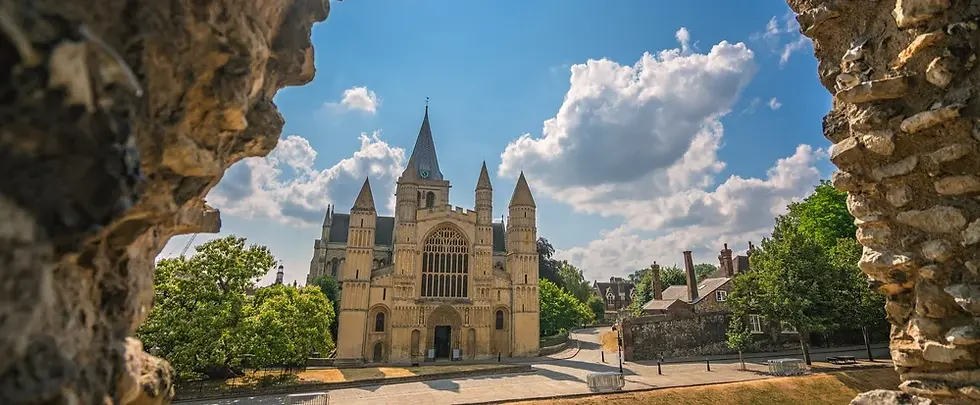
Benjamin Lany was born in Ipswich in 1591, son of John Laney, recorder of the town. A high-church royalist associated with the Laudian church, he suffered deprivation during the Civil War and rose rapidly after the Restoration:
Dean of Rochester, 1660
Bishop of Peterborough, 1660–1663
Bishop of Lincoln, 1663–1667
Bishop of Ely, 1667–1675
He was buried at Ely Cathedral.
Lincoln is where the second Lany comes into focus. Soon after Benjamin's translation to Ely, Thomas Lany, Bachelor of Sacred Theology, was collated Precentor of Lincoln Cathedral on 9 April 1667 and installed on 6 November. He held the prebend of Kilsby and died on 2 October 1669.
His worn ledger stone survives in the Morning Chapel:
Hic Iacet Eximivs Vir Thomas Lany S Theol. Bac. Ecclesiae Hvivs Cath. PræCentor Qvi Obiit 2 Die Oct. A Dom. Mdclxix.
“Here lies an excellent man, Thomas Lany, Bachelor of Sacred Theology, Precentor of this Cathedral Church, who died on the 2nd day of October in the year of the Lord 1669.”
The Precentor's Quiet Craft
In a seventeenth-century cathedral the Precentor was one of the principal dignitaries responsible for the ordering of worship and music. His stall stood on the cantoris side of the choir; the office was bound to the rhythm of daily services and the cathedral's sung life.
That matters especially in the Restoration setting. After the Civil War and the suppression or disruption of cathedral choral practice, the work of restoring ordered worship was practical as well as symbolic. Thomas Lany's office placed him inside the return of sacred voice to Lincoln stone.
The pattern becomes beautifully simple: the weaver orders thread; the shoemaker orders movement; the precentor orders voice.
Architecture becomes audible.
The Laudian Thread
Benjamin Lany's career belongs to the Restoration of a church world deeply shaped by the earlier Laudian programme: sacramental emphasis, ceremonial order, the “beauty of holiness,” and renewed attention to the material and musical life of cathedrals.
His opponents could describe him as one of Laud's creatures. After 1660, men of Lany's churchmanship returned to positions from which cathedral and liturgical order could be rebuilt.
The bishop oversees the structure. The precentor orders the sound.
Stephen Slaney's Family and the Open Name Question
A century earlier, Sir Stephen Slaney and Dame Margaret had a large family. Their son Thomas Slaney died young and unmarried, creating one of the project's recurring Thomas absences. Other children continued the family line, while men described as Slaney “cosens,” including John and Humphrey Slaney, appear within the wider merchant network.
The later appearance of John Laney, Benjamin's father, is therefore worth recording as a name recurrence. The similarity Slaney → Slany → Laney/Lany is a prompt for genealogy, not its conclusion. The carrier remains to be found.
That separation makes the route stronger rather than weaker: the names can direct the archive while the archive decides the kinship.
The Gentle Third Craft in Motion
Within the symbolic sequence, the functions align:
Stephen Slaney — civic and mercantile stewardship.
Thomas Deloney — the artisan and writer, turning craft into text.
Thomas Dekker / Simon Eyre — theatre turning craft into public myth.
Thomas Lany — the Precentor ordering sacred rhythm and voice inside Lincoln.
Benjamin Lany — episcopal authority across Peterborough, Lincoln, and Ely.
Civic stewardship becomes sacred sound and order. The maker function changes vessel while the pattern remains available for interpretation.
The Alkborough tree carvings belong to the field-witness layer of that larger story. Their marks can be documented; any relationship to the Slaney/Lany corridor remains a question to be tested.
What We Have Now
The secure historical line contains distinct people and offices: Elizabethan Slaney, Restoration Lany, merchant London, episcopal England, Lincoln Cathedral. The recurrence layer places their names and functions in conversation without pretending the documentary bridge is already complete.
That creates a living relay for the story: medieval and early-modern institutions, civic stewardship, craft, cathedral sound, and the modern maker translating the encounter into music, memoir, and father-to-son witness.
Benjamin and Thomas Lany are not an endpoint. They are the cathedral-stage vessels—the bishop and the precentor holding structure and voice in the same sacred landscape.
The work does not end when the name disappears.
The work changes vessel.
From stone to sound to music.
From record to question to witness.
The arc beneath the heart is still beating, and the Greenwood is still whispering.
The maker returns not by claiming the centre, but by walking the curve until the pattern appears.


Comments